

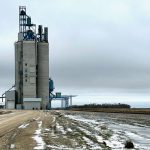
(Staff photo)

Fertilizer maker Nutrien’s profit beats on strong potash demand

Reading Time: < 1 minute Reuters – Canadian fertilizer and farm supplies dealer Nutrien Ltd reported a better-than-expected quarterly profit and raised its full-year adjusted profit forecast, driven by strong demand for its potash fertilizers. The world’s largest fertilizer company by capacity raised its full-year adjusted profit forecast to the range of $2.60-$2.80 per share, from its prior estimate of […] Read more

CN locomotives in Winnipeg. (Photo courtesy CN)

CN’s grain handle up in record quarter

Reading Time: < 1 minute Traffic in Canadian National Railway’s grain and fertilizers segment rose eight per cent in its latest quarter, helping the company to record quarterly revenue. Montreal-based CN on Oct. 23 reported net income of $1.134 billion on $3.688 billion in revenues for its quarter ending Sept. 30, up from $958 million on $3.221 billion in its […] Read more


(File photo by Dave Bedard)

Grain handle down slightly in record quarter for CP

Reading Time: < 1 minute Grain carloads were marginally fewer but grain revenue per carload climbed 10 per cent to help Canadian Pacific Railway to its highest quarterly revenue ever. Calgary-based CP on Oct. 18 booked net income of $622 million on $1.898 billion in revenues — its “highest ever (revenues) for any quarter” — in its third quarter ending […] Read more

Kristen MacMillan says interactions such as bean type, variety, inoculant type and environment can affect how edible beans interact with the N in the soil.

How much N? A soil test isn’t the only answer

Different crops, different varieties, different inoculants, and different soil environments all affect the N-application decision these days

Reading Time: 5 minutes You need to know two things to calculate your nitrogen application — the crop requirement and the available N in the soil. At least that used to be the case, but it’s not now, not since pulse crops have become such an important part of the rotation. When it comes to fixing N, not all […] Read more


Sulphur-deficient plants appear paler (foreground) than those with adequate S.

Sulphur gets hot

The nutrient’s use is definitely trending up, and there’s still more room for growth

Reading Time: 5 minutes It’s a question that’s asked of a lot of nutrients in soils across Eastern Can­ada: Is there enough in my soil, or isn’t there? Discussions surrounding deficiencies and field levels typically target macronutrients like potash and phosphorus, or even other nutrients like nitrogen, or the micronutrients magnesium, manganese, boron, zinc or copper. But sulphur sits […] Read more

Miles Dyck studied sulphur deficiency at the Breton Plots, a long-term crop rotation research site established in 1930.

Nutrient balance key to avoiding sulphur deficient soils

Production of more high-sulphur demand crops such as pulses and canola is creating a shortage in some fields

Reading Time: 4 minutes In order for any crop to use fertilizer efficiently, it needs to have all of its nutrient deficiencies met, says Miles Dyck, an associate professor of soil science in the department of renewable resources at the University of Alberta. The most common nutrient deficiencies in Western Canada are nitrogen and phosphorus, but because of the […] Read more


Soil pH is often highly variable within fields, as demonstrated in this map of a single central Alberta field. The range is from red (pH of 4-4.5) to dark lime green (pH of 7.5-8). That is why grid sampling is an important step in lime application.

If you have low soil pH, should you lime?

It can take tonnes of lime per acre to move soil pH from 5 to 7, but improved fertilizer availability for all crops, better nodulation for pulse crops and alfalfa, and reduced risk from clubroot in canola can make the investment worthwhile

Reading Time: 5 minutes “Finally.” That word got special emphasis when Doug Penney was asked about liming. “It has become a hot topic… finally.” Penney, a long-serving Alberta Agriculture fertility specialist and now semi-retired crop consultant, says many fields in Western Canada — especially in Alberta — probably would have benefited from lime a long time ago. Fields most […] Read more

A Saskatchewan potash mine under storm clouds. (BobLoblaw/iStock/Getty Images)

Global fertilizer market prices vary

Reading Time: 3 minutes CNS Canada — A mixed bag for fertilizer prices is expected over the next few months, as some continue to increase while others should drop, according to an analyst. “The fertilizer market has remained pretty firm over the past six months… we had kind of anticipated some declines across all the different nutrients, (but) they’ve […] Read more


Nutrien’s potash mine at Lanigan, Sask. The Saskatoon company said in February it expects to close some potash mines which are near their “end of life” in the year ahead. (Nutrien.com)

Nutrien steers potash recovery as BHP waits in wings

Reading Time: 3 minutes Winnipeg/London | Reuters — Canada’s Nutrien, the world’s biggest potash miner by capacity, has helped engineer a surprising price rebound for the fertilizer by idling capacity. Now the trick will be keeping prices from appreciating too much to ensure a major would-be competitor, BHP Billiton, stays on the sidelines. BHP has been weighing an entry […] Read more

Parrish and Heimbecker’s current elevator at Dutton Siding, west of Gilbert Plains, Man. (ParrishAndHeimbecker.com)

P+H to double down on northwestern Manitoba grain

Reading Time: 2 minutes UPDATED/CORRECTED, Aug. 17 — Winnipeg grain company Parrish and Heimbecker has plans to double its grain handle out of northwestern Manitoba with a new elevator and crop input centre. The company announced Aug. 1 it will put up a new facility in the RM of Gilbert Plains, with 25,000 to 30,000 tonnes of storage capacity […] Read more