

Canadians are changing how they eat and those shifts are beginning to ripple back through the food system.
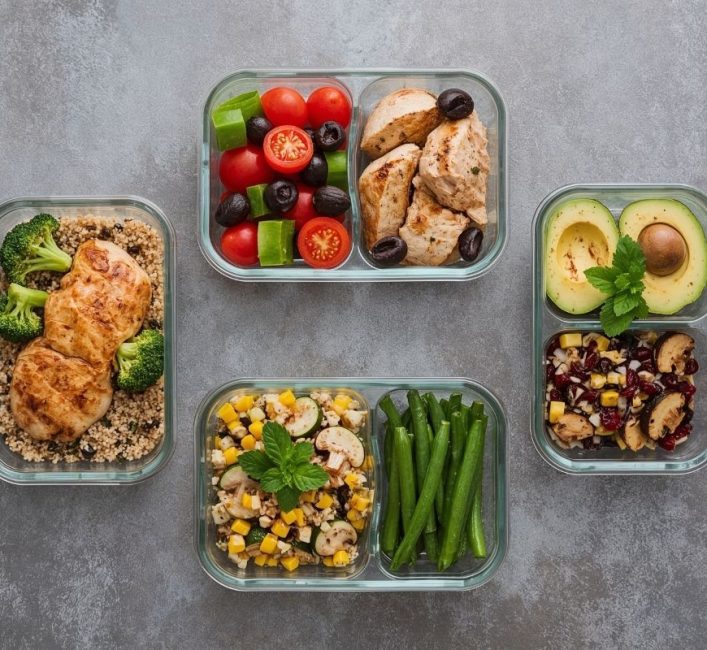
Faced with higher living costs and changing lifestyles, consumers are eating out less, cooking more at home, replacing meals with snacks and putting a sharper focus on value and nutrition.
And for Canada’s farmers and agri-food sector, the changes bring both risks and opportunity.
Read Also

Farm & Family – March 27 edition
Trust, teamwork and resilience: three ingredients every farm family knows they need to run a farm. But wait until you…
Canada’s restaurant and food service sector is a $124-billion industry, which sources approximately 68 per cent of its food and beverage from domestic suppliers. When restaurant traffic slows, the impact is felt throughout the supply chain.
At the same time, experts say that evolving consumer habits are creating new demand for the products, production methods and innovation that the Canadian agri-food industry is uniquely positioned to offer.
Current trends
The most immediate change is happening in restaurants.
According to a recent report, three quarters of Canadians are eating out less often. The primary reason for this is economics, says Sara Hamdy, research analyst with Restaurants Canada.
“More than 40 per cent of Canadians just can’t afford to dine out month to month as much as they’d like to,” she says.
According to the same report, even higher-income households are cutting back.
“Canadians who are dining out once a week or more are shifting to … maybe two or three times a month rather than four times or more,” says Hamdy.
At the same time, restaurant operators are facing their own cost pressures, with food costs cited as a top concern for the year ahead, Hamdy says.
Another emerging trend for Canadian consumers is a rise in snacking. About 65 per cent of Canadians report replacing full meals with snacks at least once a month, according to the Restaurants Canada report — a trend driven by both rising food costs and busier lifestyles, says Hamdy.
“This is a trend that we noted in a way that Canadians are adjusting to the increase of cost. They’re just not able to afford a full meal anymore, so they’re cutting back into snacks.”
Younger consumers in particular are gravitating toward portable, lower-cost options that fit a “grab-and-go” routine, she says.
But these changing eating patterns have not affected consumers’ desire for value, which dominates Canadian food choices today, says Ashley Kanary, director of Global Agri-Food at Export Development Canada.
After the pandemic, many consumers returned to simpler eating habits and became more conscious of prices, he says.
“When people looked at ways to save money, food was one of the first things that came out pretty hot.”
However, at the same time, consumers didn’t want to cut back on quality or health, he says.
These factors combined helped fuel strong growth for private-label grocery products, which now rival or outperform national brands in quality while offering savings of 15-20 per cent.
“When I look at those trends, that has not slowed down at all,” Kanary says. “If anything, globally, private-label products are outpacing all branded product growth, no matter where you go.”
But value shopping also doesn’t mean consumers have stopped treating themselves, he says.
“Even as people tighten their budgets, the indulgence factor is still there. In private label, everybody’s raised their game, and those products are as good, or even sometimes better than the national brand themselves. People are saying: ‘If I can get something that tastes better for 20 per cent less, I’m absolutely okay with that.’”
Beyond affordability, nutrition trends also continue to shape consumer behaviour, he says, with one of the strongest long-term shifts favouring higher-protein foods.
The challenge now, he says, is raising the taste profile in high- and added-protein products. “The desire … is to get things to taste great,” Kanary says. “People have always struggled getting around the added taste and or bitterness that protein-added causes.”
One final trend with long-term implications is sustainability, Kanary says.
Retailers and food companies are increasingly expecting suppliers to meet environmental standards, from emissions reductions to compostable packaging, but without charging more for the associated products.
“Sustainability expectations are rising, but consumers aren’t willing to pay a premium for it,” he says.
“They’re actually saying: ‘I want you to become sustainable and don’t charge me extra for that. We just need you to get better and raise your game.’”

Canada’s advantages
Despite the constraints these evolving eating habits cause for food supplies and producers, Canada is well positioned to meet many evolving consumer expectations for food, specifically around protein, sustainability, value and convenience.
“We feel that protein overall is where it’s at and Canada has amazing strengths in protein,” Kanary says, mentioning Canada’s pulse, poultry, seafood and beef industry as examples of high-quality protein sources.
He also believes Canada could have a competitive advantage in terms of rising sustainability expectations — provided companies can deliver results without higher costs.
“There’s an opportunity for Canadian companies to be leaders in sustainability on a global scale and I believe Canada is really strong in this area,” he says. “The key is to keep that momentum going, but not at any cost.”
Changing eating habits are also driving demand for portable, convenient options that still deliver quality and nutrition, another area where Canada is gaining ground as our food manufacturing sector expands its role in value-added products.
Food and beverage processing is now Canada’s largest manufacturing industry, with shipments topping $156 billion in 2023, according to Statistics Canada. Much of that growth is coming from ready-to-eat and snack categories, while Agriculture and Agri-Food Canada reports rising exports of consumer-oriented products such as processed foods. This points to growing opportunity for Canada to capture more value beyond the farm gate while supplying the convenient, high-value foods today’s consumers want.
Going forward
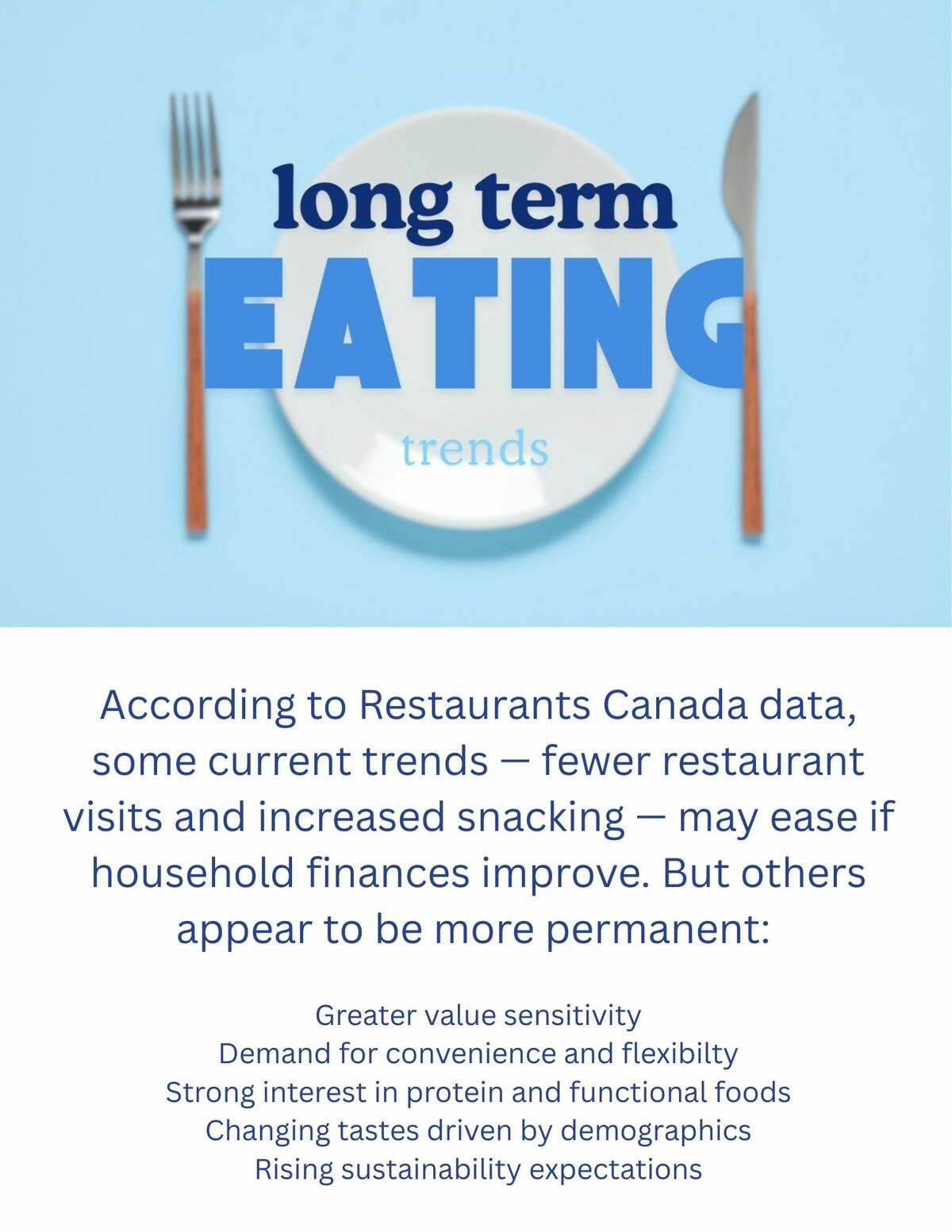
Some of the current eating trends for Canadians — fewer restaurant visits and more snacking — may ease as household budgets recover.
But several underlying shifts appear more durable, including greater price sensitivity, demand for convenience and flexibility, stronger interest in protein and functional foods, and rising sustainability expectations.
For Canadian farmers and processors, the key takeaway is that demand is not shrinking, but it is changing. Growth opportunities are increasingly tied to value-added processing, efficient production. and the ability to supply ingredients that fit portable, affordable and nutritious food formats.
At the same time, Canada’s strengths in high-quality protein production, strong environmental performance and an expanding food manufacturing sector position the industry to compete in both domestic and export markets.
The pressure, however, will be on cost competitiveness. Consumers and retailers are expecting better performance on price, quality and sustainability at the same time, putting greater emphasis on efficiency and innovation throughout the supply chain.
The direction of demand may be shifting, but the long-term outlook for Canadian agriculture remains strong. The farms and agri-food businesses that succeed will be those that focus not only on production, but on understanding how and where their products fit into a food system that is becoming more value-driven, more convenience-focused and more closely tied to consumer expectations.