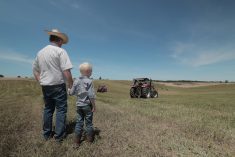

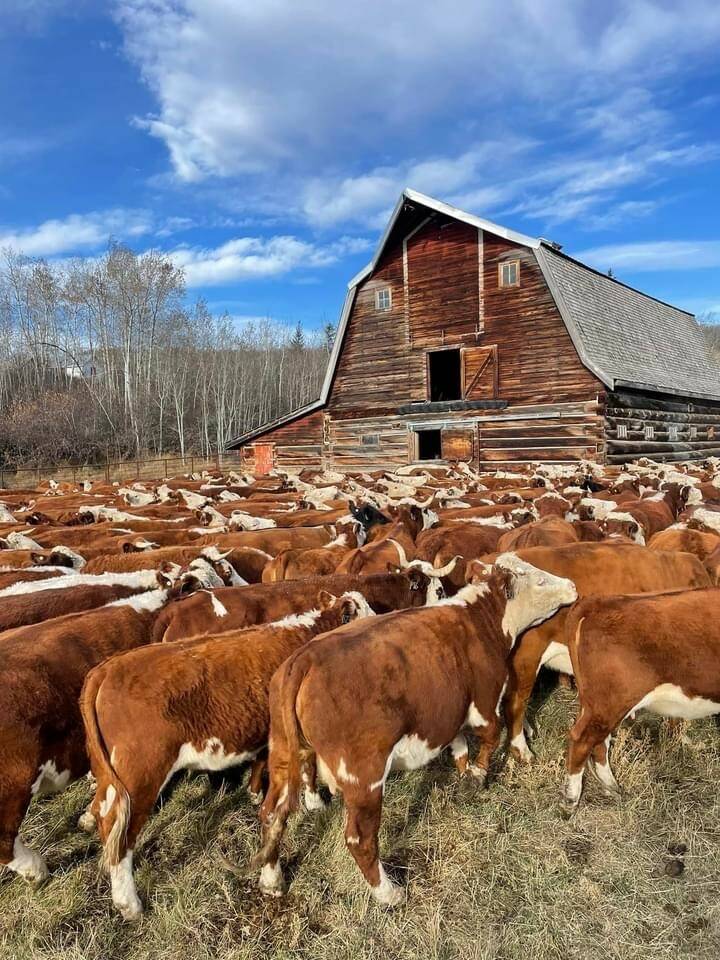
British Columbia’s Ardill Ranch was awarded a Century Farm designation in 2020.
Renee Ardill, who was featured in the March 5 issue of Farm & Family (powered by Country Guide), recounts her family’s ranch history below.
Read Also
B.C. Century Farm focuses on protection and quality of their herd
Despite numerous challeges past and present, this B.C. ranch focuses on what’s within their control to face industry headwinds.
“My ranch started in 1920 when my grandfather, Jack Ardill, settled here,” says Renee Ardill, owner of Ardill Ranch which is 30 kilometres east of Hudson’s Hope in the Peace River region of British Columbia.
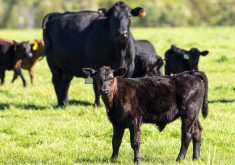
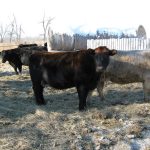
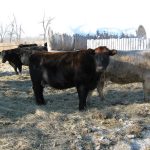
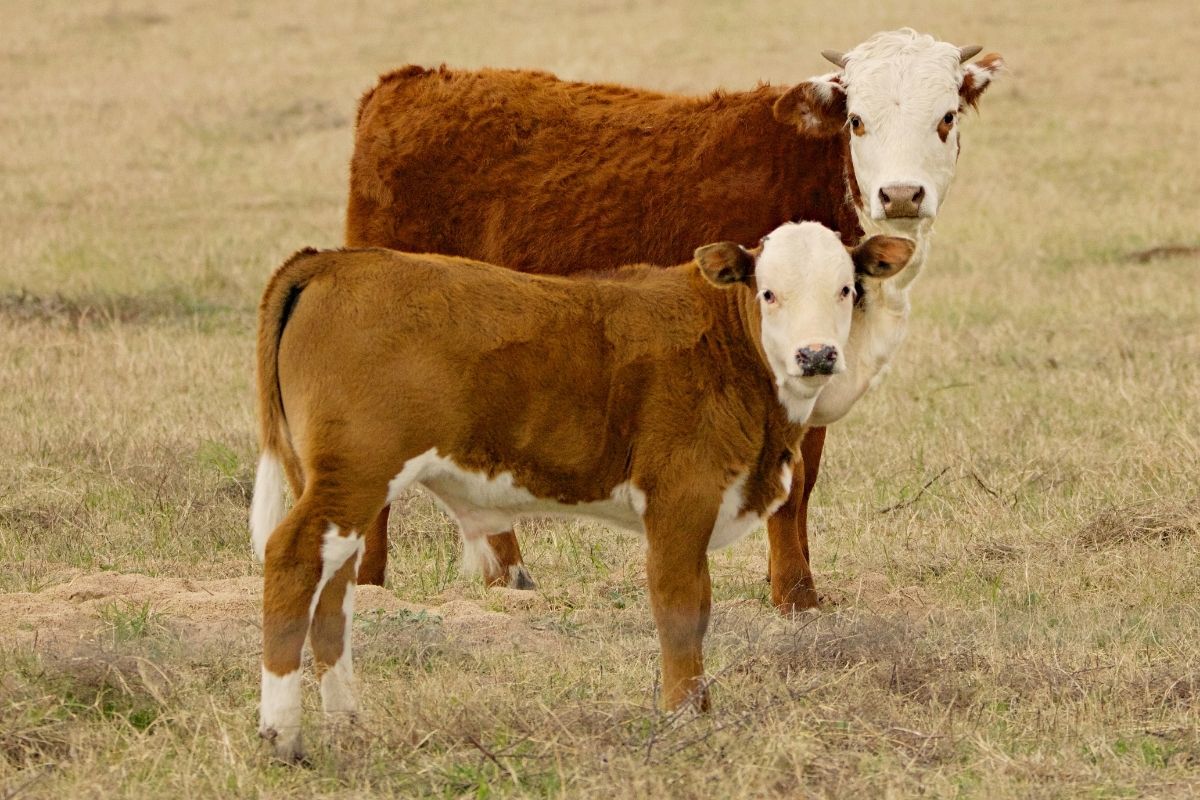
Ardill runs 350 Hereford cows in a cow-calf operation on 36 sections and maintains 30 head of working Quarter horses.
“[My grandfather] was born in 1890 and came from Ireland to Canada in 1909 at the age of 19,” says Ardill. “He worked on the Bonaparte Ranch. He was there for a couple of years before going off to see more of the country and got a job as a surveyor’s helper, working in the Athabaskan area.”
With the onset of World War l in 1914, Jack joined the Canadian Expeditionary Force. Along with fellow soldiers, he was sent to England then served in the British Army in Europe.
He experienced fear as a prisoner of war and pain as an injured soldier. But beyond the disease-ridden, rat-infested, muddy trenches, the terrifying whizzbang of German howitzers, and soldiers’ cries of despair, Jack clung to his vision of a Canadian future.
“While recovering in Holland he met his future wife Betty, my grandmother, and together they returned to Canada,” says Ardill. “He had heard about the Peace River country from a friend who told him that if he survived the war he should go to the Peace.”
It was sage advice.
As war raged, the Peace region was undergoing its transformation into an agricultural heartland thanks to the geologic output of Ice Age cycles. For two million years, massive glaciers had ebbed and flowed across the landscape of hills, valleys, lakes, rivers, swamp and muskeg, grinding rocks and boulders into soil as fine as flour. This glacial loess (a fine-grained sediment formed during the Ice Age) became swaths of poplar, aspen and spruce interspersed with fertile grassland.
It was a farmer’s dream.
The promise of cattle and grain farming attracted settlers to the region. The Dominion government controlled what was called the Peace River Block, an area some 3.5 million acres. In 1912 it opened the region for homesteading. Settlers would receive a quarter-section of land for the nominal entry fee of $10.
There were further benefits for soldiers returning from the war. Under the Soldier Settlement Act, they received a free homestead entry plus access to very generous government loans to purchase livestock, equipment, supplies and home building materials.
Jack and Betty returned to Canada in 1919. When Betty became pregnant, she moved to Edmonton and stayed there until their first son, John, was born in February 1920. (John would be followed by Betty, Richard [Dick] and Tom. Dick is Renee’s father.)
Jack remained in B.C. He had never forgotten the advice from his friend about settling in the Peace. He scouted for land and found what he had dreamed of located on the banks of the Peace River near Farrell Creek just east of Hudson’s Hope. He filed for a Homestead and Soldier’s Grant and, in 1920, Jack, Betty and their young son, John, moved west to launch Ardill Ranch.