
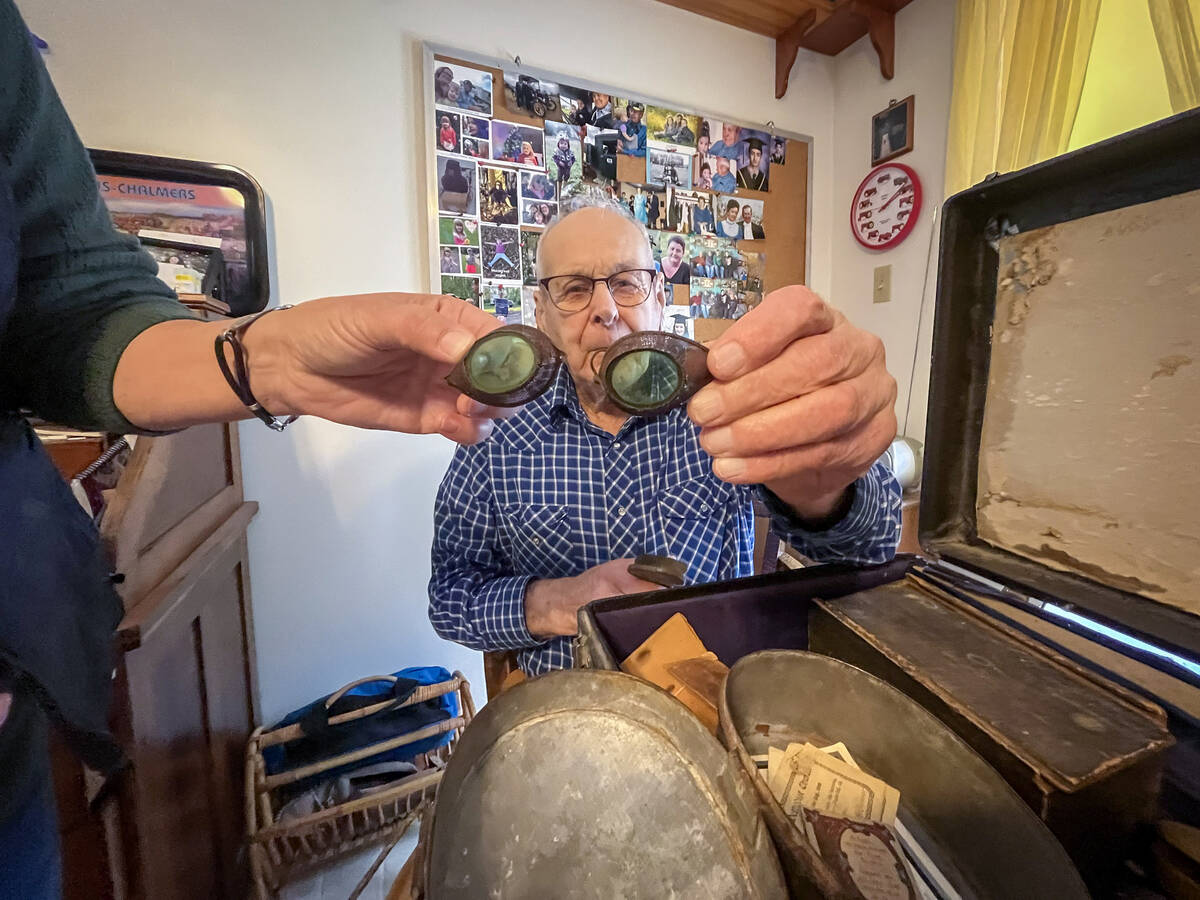
Did nineteenth-century Manchester (U.K.) coal miners eat sandwiches? If so, they could carry one to work in their tin lunch box, possibly with space left for an apple.
Grandpa William Allinson’s lunch kit is one of the first items Dave Allinson and his daughter, Diane Rourke, unpacked from an old suitcase of treasures to show me.
There was also a box of old receipts showing the price of food items some time ago: two dollars for a sack of flour, 41 cents for tea. Some of it was paid for with butter from the Allinson farm just outside Starbuck, Man.
The Allinsons have kept many of their family artifacts. They have the stories to go with them, too. In recent years, Rourke’s aunt, Mae Denby, passed on stacks of notes and tape-recorded interviews she’s conducted with family members.
Rourke’s project is to compile everything into a narrative for an in-the-works Starbuck community history project.
But what about farm families who are starting from scratch? How do they start putting together a farm and family history?
SIT DOWN AND TALK
A simple place to start may be to get a few family members together, turn on a recorder and talk.
This is the approach Mae Denby took over the decades. When she’d visit her sister Lois Allinson, and Lois’s husband Dave, she’d switch on a tape recorder and begin asking questions.
Denby told me she’d think ahead about what aspects of family history she wanted to discuss.
“Then I’d start with kind of open-ended questions… (questions) that start with ‘tell me about,’” Denby said from her home in Winnipeg.
Starbuck residents took a similar approach while researching for their community history book. They held an open house and started telling stories and they visited the “old-timers,” says author and researcher Gordon Goldsborough, who is acting as a consultant for the community.
“We got all kinds of little nuggets,” he says. “Like the time they set the local bridge on fire. It’s probably recorded nowhere else, but everyone remembers it.”
These days, smart phones usually come with voice notes or recorder apps that can capture a conversation. Some will even produce a transcript of what’s said. If not, there’s an app for that too. Just keep in mind that the transcript probably won’t be 100 per cent accurate.
However, this approach will only produce as much history as living family members can remember. The rabbit hole goes much deeper, if desired.
DETECTIVE WORK
Part of the Starbuck history project involved writing an overview of the region’s agricultural history. Local memory took them back as far as the 1960s or 1970s.
“That’s okay, but what was happening in the 1910s?” Goldsborough asks. “That’s where you switch to these other sources.”
For example, Goldsborough introduced the group to archival research, touring Manitoba’s provincial archives or searching libraries at the University of Manitoba agriculture census records.
These are likely to yield more general information than specific — e.g., primary crops in a region in a given year — but could provide important context to family history.
Many communities have their own archives, as do many newspapers. If possible, work with an archivist or someone who knows the records collection well.
A local genealogical society may also be able to help, particularly with chasing down public records. They may also have their own library of local records and histories.
A brief list of potential sources:
- Community history books
- Provincial archives
- Local and town archives
- Census records
- Agricultural census records
- Phone books or community directories
- Vital statistics (online through Library and Archives Canada)
Read part one ‘Why you should preserve your farm’s history’ here.
PUTTING IT TOGETHER
The question may then be how to turn all this information into a usable story.
Denby is preparing to write her own memoir — and she’s the right person to do it. She taught memoir, or “life writing” as she calls it, for many years. Finding a similar course in person or online may be one way to start.
Denby says she would start her students with a word association exercise in which she’d list 15 things, for example “family gathering” and “kitchen window”, and students would write a few words about anything that came to mind.
In groups, they discussed what they came up with and narrowed down which ideas were worth telling stories about. Then, they would take time to write about some of them.
“They would get quite excited about their writing and the fact that they could actually tell a story in writing, which is quite intimidating for some people,” Denby says.
Denby would then discuss with them ways they could organize a book, for example, by decade or based on important people in their lives.
They would also walk through technical aspects of writing, such as how to craft dialogue.
She would also encourage them to begin writing their story at a comfortable spot. Yes, talking about the hard part of one’s story is good and necessary, but it may be better not to start there. “They need to get confidence in actually putting words onto paper,” she said.
Denby says that written family histories are valuable because families move around.
Artificial intelligence may also lend a hand with turning research into a narrative, says genealogist George Mackay.
Just keep in mind that artificial intelligence usually requires a human editor.
There’s also the video route. For example, agriculture coaching and consulting firm Loft32 helps farm families create six- to eight-minute videos telling the history of their farms. These incorporate interviews with family members and historical photos, if desired, says Maggie Van Camp, co-founder of Loft32 and director of strategic change.
Jeff and Sheila Elder preserved their farm story in a photo book compiled through an online service. The book contains historical photos and present-day pictures of the preserved historical buildings on the farm along with captions and stories explaining the history behind them.
Family tree charts, simple binders of notes and written captions on the backs of family photos may also be helpful ways of keeping the story intact.
WHAT ABOUT HEIRLOOMS?
What about family artifacts and heirlooms?
There’s value in writing down the story behind the artifact and perhaps storing the story and heirloom together. For instance, a Singer sewing machine is just a hunk of metal unless the family knows Oma brought it on the boat from the Netherlands and sewed her kids’ clothes with it.
If it’s a matter of determining what an object is, a museum curator may be able to help or may know someone who can, says Tricia Dyck, collections and programming manager at the Manitoba Agricultural Museum.
Online groups and information are helpful, but it can sometimes be hard to know if you’re actually looking at the same object, she adds. In that case, an expert may be your best bet.
It may also be worth looking the article up online or asking an expert, such as a museum curator, how best to store heirlooms to ensure they don’t deteriorate.
However, as family members move or downsize, there may be no place for Grandpa’s tractor. What then?
Donating to a museum might be an option but understand that museums can’t take everything that’s offered to them.
“We actually have a job as a museum to care for it forever, so that’s a big resource requirement,” says Dyck.
When an item is offered for donation, whether it’s a document, tractor or textile, the museum will consider things like the item’s condition, uniqueness, its importance to local and regional history, the care and resources it will require, and how it can be used in education and interpretation.
If one museum can’t take the artifact, it may be worth asking another, Dyck says. That heirloom may simply be outside the scope and mandate of the museum, but another organization may be happy to take it.
And there are probably far more museums than people know, she adds.
Some institutions will also take farm records. For example, the Archives of the Agricultural Experience at the University of Manitoba has a broad collection of records that document facets of Prairie agriculture.
While the archive focuses more on grain companies and co-ops, it also includes records from individual farms, says archivist Brian Hubner.
He says the archive accepts farm records on a case-by-case basis. Records that contain unique or outstanding features, e.g., a long and continued history, increase the chances that the records will be accepted.
WHEN ITEMS CAN’T BE SAVED
Some families may need permission to let an item go.
Dyck says people often tie a lot of emotion to heirlooms. If they don’t know how to preserve them or where to place them, they can feel like they’re letting the family down.
She encourages families to find ways to pass on the legacy, even if the object can’t be kept, perhaps by taking a picture of the object or writing down the story behind it.
“Sharing stories, recording memories, or creating small family rituals can carry the meaning forward,” Dyck says. “These acts allow the history, the values and the connections behind the heirloom to live on quietly with us and with future generations.”
Read part one ‘Why you should preserve your farm’s history’ here.
Read Also
Farm & Family – April 17 edition
There are three key activities in farming apart from feeding, planting or harvesting: management, planning and problem solving. This week’s…