

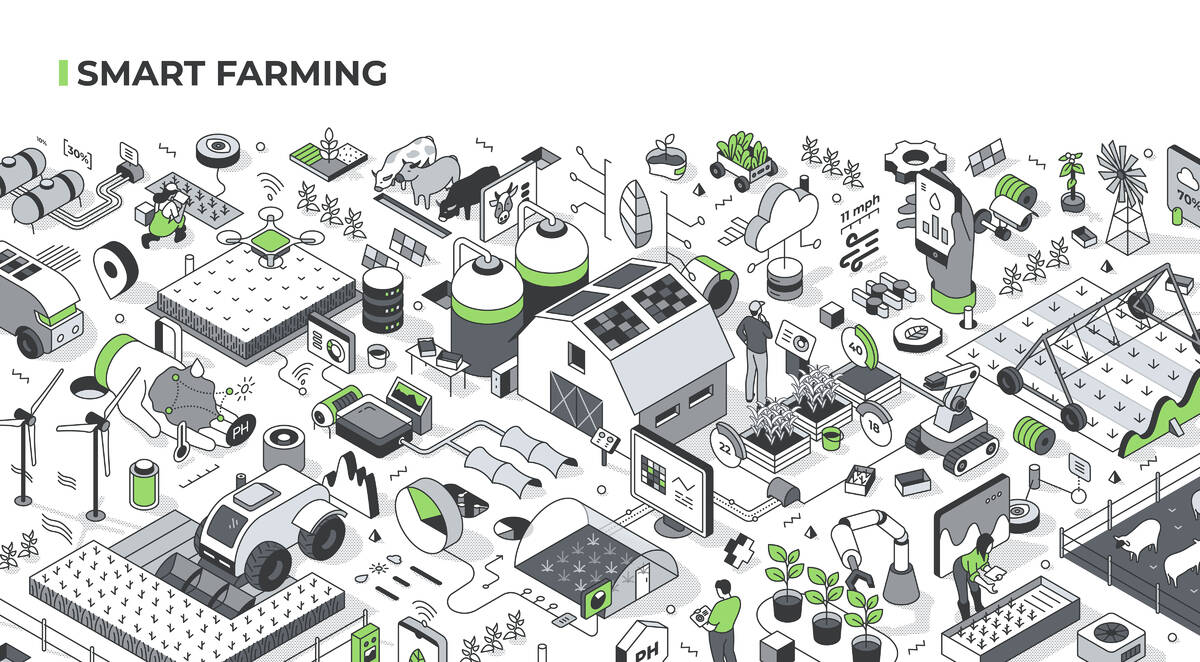
Artificial intelligence (AI) is everywhere, disrupting everything from internet searches to the movie business. While you’re reading this, someone else has started selling a new AI tool.
But is AI everywhere except on your farm? Are you missing out on the new revolution?
Here’s the good news: You’re already using AI and other people are using it in ways that benefit your farm. So, taking the first step is not as scary as you might think.
Read Also
Farm & Family – April 10 edition
This week’s newsletter feels very on point with recent news cycles: the constant spectre of uncertainty and volatility. BUT you’ll…
But first, what exactly is AI?
Defining AI
There’s no single definition for artificial intelligence. AI is used in all kinds of ways to describe many different things. Generally, AI is a process where computers do something normally done by humans. This could be something complicated, like a computer model that forecasts climate change, or something simple like a heater that turns on when the temperature drops.
Some people default to thinking of “chatbots,” such as ChatGPT, when they think of AI. Chatbots are software programs that can answer questions based on information they’ve “read,” and sometimes generate new information.
There’s more to AI than chatbots, but chatbots are a key piece of the puzzle.
For this article, ChatGPT was asked to define AI for a farm audience, using an account personalized to use a “critical and sarcastic” tone. This is ChatGPT’s response:
Imagine a smart hired hand that never sleeps, doesn’t complain about the weather, and works from data instead of gut feeling. It can read soil maps, predict yields, plan spray timing, monitor livestock health, or even drive machinery — though it still can’t fix a seized bearing or find that one missing wrench in the shop. In short: AI uses information to make smarter, faster choices. The farmer’s brain is still the boss; AI just crunches the numbers faster than anyone with a coffee thermos ever could.
You’re already using AI
Dr. Felippe Karp, instructor and researcher at the Werklund School of Agriculture Technology at Olds College of Agriculture & Technology in Alberta, opens his presentations about AI by telling farmers that it’s not the future, “It’s the present.”
Do you use an app to check the weather? “Guess what?” Karp said. “There’s AI behind that.”
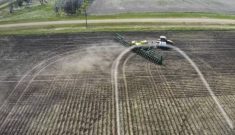
Machinery automation is also AI. “Auto-steering is one of the most adopted precision agriculture systems,” Karp said.
Auto-steer equipment is driven by an algorithm that uses data from satellites and field locations. The algorithm directs the machinery so it can steer without human intervention.
Automation in newer combines also uses AI. It’s changed combines to the point that, Karp said:
“Someone with no experience running the equipment can jump in there and run it.”
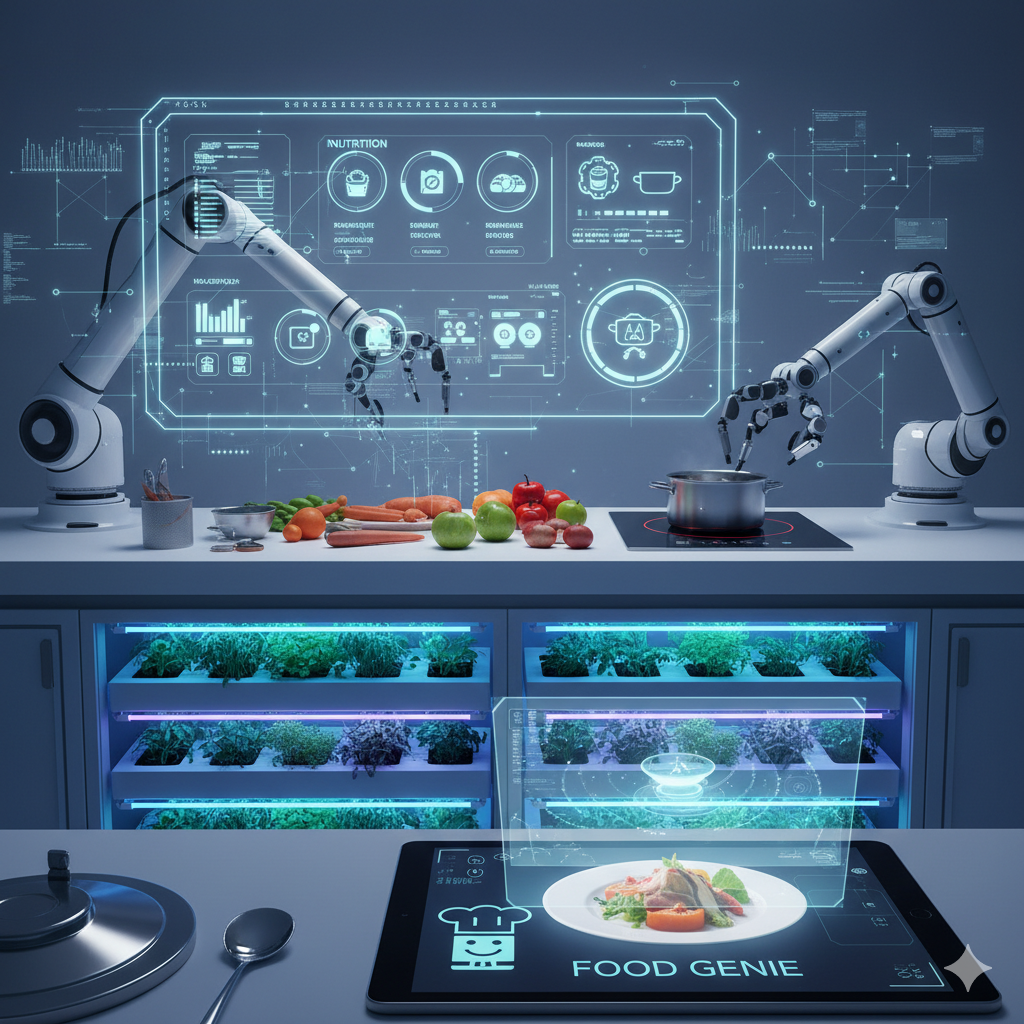
Given the shortage of ag employees Karp added, “This is quite amazing.”
Knowing we already use AI makes it easier to take the next step. “We need to demystify AI,” Karp said. “It runs in a hidden way where we don’t directly interact with it, but it makes our lives easier.”
Smartphone apps that identify weeds, insects and disease are also AI at work. “This can empower people that might not have the expertise to go in the field and do some scouting for you,” he said.
However, powerful AI doesn’t replace real farmers and experts. For example, Karp suggests, imagine your phone app misidentifies a bug. You still need a farmer or agronomist with field experience to detect errors.
“This critical thinking portion is key,” he said.
Karp and other instructors at Olds College are training students to think critically about results from AI and help students see where they can add value in a world of rapidly changing technology.
Researchers are using AI for you
Dr. Rozita Dara is the director of Artificial Intelligence for Food (AI4Food), a technology hub at the University of Guelph that promotes responsible development and use of AI in Canada’s ag and food sector. Dara agreed that Canadian farmers already use AI in many ways, most of which are rather simple to explain.
For example, many AI tools have been developed for greenhouses. “Because it’s a relatively controlled environment, it’s easier to develop AI solutions,” Dara said. AI-enabled equipment helps greenhouse managers decide when to spray and how much to irrigate.
In poultry barns, cameras connected to AI systems can monitor animals for stress. Human experts “teach” the systems what kinds of movements and behaviours to “watch” for before the system is operable.
“When we build AI solutions it’s always with humans in the loop,” Dara said.
More complicated cases
“Generative algorithms” don’t just analyze data; they also build on it to create new information. These algorithms are complicated, so the results can be less predictable than, say, a steering wheel that makes a turn if a rock knocks the tractor off its straight course.
Because they’re more complex, generative AI systems have been known to go off the rails and provide very incorrect results. This has been referred to as “AI hallucination.”
Because this can happen, we’ll always need people to verify complicated results. Dara encourages farmers to “trust the technology but also validate.”
Dara’s current project is an example of a complicated algorithm guided by humans. Dara and her team are combining several data sources to detect avian flu outbreaks in its early stages, with the goal of getting information to decision makers.
Their data includes everything from satellite images to social media posts. AI looks for patterns in reams of data, identifying correlations that humans might miss.

“Our goal is to extract risk factors from these data sets.”
Dr. Rozita Dara, director
Artificial Intelligence for Food (AI4Food)
Dara’s team can detect potential avian influenza outbreaks two or sometimes three weeks before it’s been officially confirmed. The extra time helps decision makers monitor and act before an outbreak becomes severe.
Meanwhile, scores of other ag researchers are using AI in their labs to analyze genetics for faster plant breeding, correlate satellite data with in-field information for optimal cropping information and speed up every area of ag research you can imagine.
It comes down to good data
Much of the work is less than glamorous.
“AI is 90 per cent data,” Dara said. “People don’t understand the effort we put into data cleaning. It’s 90 per cent of the work.”
Karp has also spent more than his share of time processing data for AI. “We have to guarantee that good data is coming in,” he said, referencing the “garbage in, garbage out” maxim of computer models.
For example, crop yield maps show variations throughout the field. “We know that this is based on sensors,” he said. “Sensors can get things wrong.” Yield maps are only useful after any sensor errors are found and corrected.
There is a lot of data to clean. But AI becomes more powerful when it has access to multiple data sets, what Karp calls “data fusion.”
For example, adding yield data to rainfall data, along with soil test and EC (electrical conductivity) data makes a database that would drown an Excel spreadsheet.
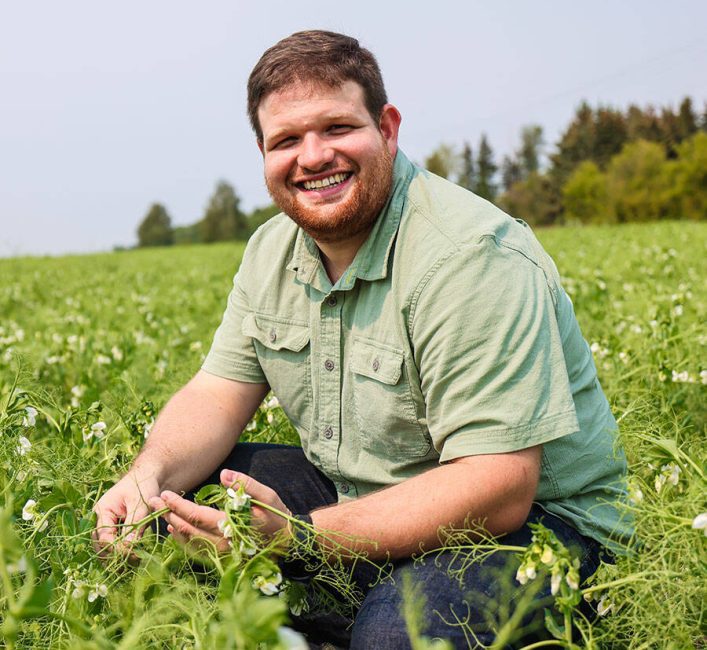
“Imagine how powerful this information could be if we were to build models based on this data.”
Dr. Felippe Karp
Werklund School of Agriculture Technology, Olds College of Agriculture & Technology
He believes data fusion will let AI empower ag decision makers at a new level, bringing on a “digital revolution in agriculture.”
It’s all coming together, but a lot of the work is still at the “data collection” point.
Eventually, data-empowered AI will identify patterns and forecast results, giving farmers better insights into questions such as: Do your strawberries need pest control? Is it a good time to price your feed barley?
“But who makes the final decision?” Karp said. “The farmers.”
Here’s how to start now
You can start your AI journey at home, right now, with Farm Credit Canada’s (FCC) chatbot designed just for Canadian farmers.
Nicole Hayes, director of FCC’s Innovation Hub, said FCC found “producers were feeling the gap in availability of advisory services across Canada.” A chatbot that could answer agronomy and farm management questions could fill that gap and also be a safe space for farmers to learn to integrate AI into their businesses. The first version of FCC’s chatbot called Root was released in July 2024.
“Root is a great starting point,” Hayes said.

“It’s free, it’s available to everybody. It’s a great tool for people to start becoming more comfortable asking questions and getting responses, engaging in that dialogue.”
Nicole Hayes, director
Farm Credit Canada Innovation Hub
Unlike other chatbots, with Root, Hayes said, “We can ensure that the dialogue that we’re engaging in is focused on agriculture.” FCC only allows Root to base its chats on reliable information. “We’ve done some of that fact checking and validation behind the scenes,” Hayes added.
Root can “chat” with farmers based on Agriculture and Agri-Food Canada information and databases, FCC information and other sources FCC deems trustworthy. “We’ve got quite a substantial database that exists underneath the surface,” she said.
For now, users might find Root’s answers to be a bit limited, but that will change. “We’re at the early stages of development. It’s something we’re continuing to build and expand on. We are continuing to expand the knowledge sources that we’re using and who we’re partnering with in the industry.”
Even more options
In October 2025, Wharton Business School listed the top chatbots used by business leaders to analyze data, summarize reports, make presentations and generate ideas. ChatGPT and Microsoft Copilot were the most common off-the-shelf chatbots. Some businesses build their own custom AI models, with access to confidential internal data.
Create your own free account at ChatGPT.com and ask it about your farm (or anything, really). It finds information faster than a Google Search, does math quicker than your calculator, and writes business letters more formally than your seventh-grade English teacher.
When asked “What’s the best fertilizer rate for canola?” ChatGPT led with: “There’s no magic number that fits every field — if there were, agronomists would be out of work and the rest of us could just read the bag.”
It also provided some general NPKS guidelines and a recommendation of 80 to 150 pounds of nitrogen per acre.
A free account on Microsoft’s Copilot (which comes bundled with most Microsoft Office software) said the best rate “depends on your yield goals, soil nutrient levels and environmental conditions.” Copilot suggested 125 to 150 pounds of N per acre and also listed reference links, with one to the Canola Council of Canada.
Root wouldn’t go out on a limb with a suggested rate, which was sensible given that it didn’t know how much N is already in the soil. However, Root listed factors to consider, mentioned 4R fertilizer practices and referenced an Agriculture and Agri-Food Canada article titled “Managing nitrogen use efficiently.”
Using Root feels a bit like asking your sensible uncle. You’re not likely to get the wrong answer, and you might need to use its suggestions (links) to find the answer on your own. Other chatbots respond more like your wild cousin.
Did ChatGPT or Copilot give better responses? That depends on your field and your own expertise.
Ask harder questions
Don’t be afraid to ask more difficult questions. Chatbots are great at brainstorming and they may come up with answers you weren’t expecting, but do take a critical look at the answers.
When asked for suggestions for new crops in southeast Saskatchewan, Root provided great links and resources. When pushed, it suggested quinoa.
ChatGPT suggested a long list of crops that included soybeans and sunflowers but not quinoa. When asked, “What about quinoa?” ChatGPT “answered”:
“Ah, quinoa — the hipster of grains. Everybody loved it until they realized it was actually hard to grow here. Then they went back to complaining about canola.”
ChatGPT was willing to forecast revenues and expenses for a new crop — making the kind of assumptions Root would never make. It wasn’t always 100 per cent correct, but it wasn’t ludicrously wrong. Responses like this are either extremely helpful, or very dangerous. As Dr. Dara would say, “verify.”
You know more about your farm than a chatbot, but interaction can still help you come up with new ideas.
What’s next?
“In the coming months or years,” Dara said, “there will be many more AI assistant tools that are more reliable. They will definitely become much smarter.”
Whether or not you use it, Dara said “this technology is here. It’s not going to go away.” AI will be embedded in many of the tools we use, on or off the farm.
“Just as we can’t say ‘no’ to mathematics, we can’t say ‘no’ to AI,” Dara said.
“Eventually AI will be everywhere, and agriculture and food cannot fall behind.”