
What motivates one farmer to make a succession plan while another doesn’t seem worried about having a plan at all?
New research out of the University of Alberta explored what motivates or deters farmers from developing a succession plan.
Rather than duplicating resources already available that deal with the nuts and bolts of the transition process, the research team, led by Rebecca Purc-Stephenson, a professor of psychology at the University of Alberta, decided to focus on the psychological factors that may be motivating or holding people back from creating a succession plan.
Read Also
Farm & Family – March 6 edition
Can a farmer also be a conservationist? The short answer is “yes.” But it’s a balancing act and an on-going…
The researchers interviewed 16 farm families across Alberta, speaking privately with the main farm operator and separately with one other farm family member.
“That proved to be very important because we found that there was not a lot of open communication when it came to farm succession planning,” Purc-Stephenson says.
From those conversations she discovered that whether someone creates a succession plan or not depends on their stage of readiness.
“The Stages of Readiness is a common framework for behavioural change,” Purc-Stephenson explains. “Everyone is at different stages of readiness, and in relation to farm succession planning, it’s helpful to know where they are in that process, so we know what kind of information to share with them and don’t overwhelm them.”
This led her team to create the Farm Succession Readiness Framework. The framework shows that farmers fall into one of four groups: active planners, back burners, succession avoiders and end-of-the-line farmers.
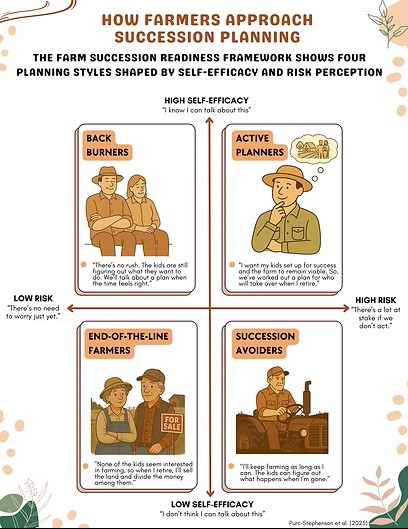
Several factors influence which readiness group people end up in. Apart from predictable factors, such as a farmer’s ability to continue to do the actual physical work, there are a number of underlying issues, such as the perceived risk of having or not having a succession plan and people’s level of comfort with having family conversations about transition of the business.
The perception of risk
“Perceived risk was central to the framework, and it referred to how farmers interpret the potential consequences of having or not having a plan in place,” Purc-Stephenson says.
“Especially for farm operations that were large and had many assets, a farm succession plan was seen as something they needed to have in place because they have a lot at stake. Those who had a plan were looking forward and wanted to protect their existing assets, to grow and ensure that the farm could be viable for their children.”
The active planners were the smallest of the four readiness groups. In fact, only two farmers out of the 16 interviewed had a formal, written succession plan.
“The active planners had a team that was dialed in, they maybe had financial planners with agricultural backgrounds, they were always seeking advice or getting tips on how they could modify their plan. But it wasn’t a one-shot plan, it was an ongoing discussion,” Purc-Stephenson says.
The back burners, by far the largest group, viewed the risk of not having a transition plan as low.
“That tended to be farmers in their late 40s to early 60s, that thought it’s not urgent, we can do this later, we have lots of time,” says Purc-Stephenson.
“When there’s that low perceived risk, there’s no action and people can get comfortable in their roles, time passes by, and nothing has actually happened.”
At the other end of the spectrum are the end-of-the line farmers who have no one to pass the farm on to. They also didn’t see the lack of a plan as a risk because as they planned to ultimately sell the farm, they didn’t believe there was as much at stake.
Family harmony
Family relationships are another factor that prompted some farmers to become active planners.
“Succession planning can be seen as a way to maintain family harmony and ensure that the family stays together, with the thought, for example, that if we don’t deal with this now, it will become a problem later,” Purc-Stephenson says.
That wasn’t always the case though, especially where there were differences in how mom and dad looked at transition.
“We found that often, with the husband, the father, what they deemed as fair may not have been equal across children,” Purc-Stephenson says.
“It was rather who had contributed most and would ensure that the farm would remain viable would get a ‘bigger piece of the pie.’ Whereas, consistently, mothers wanted to ensure that things were equal so that family could continue to get along. And sometimes that tension actually stopped communication.”
Multi-generational farmers were also more likely to look at the risk to their legacy.
“For those fourth- or fifth-generation farmers, being able to maintain that farm legacy was important because they view themselves as part of the lineage,” Purc-Stephenson says. “Their identity was so closely attached to the farm, the land and the story, that it was important for them to be able to pass on the farm and for it not to end with them.”
Helping the succession avoiders
Succession avoiders might be the group that needs the most help with succession planning. Their lack of motivation to plan comes from a fear of stepping down from their lifelong roles and of having difficult family conversations. The attitude is typically “I’ll keep farming as long as I can. The kids can figure out what happens when I’m gone.”
For them, bringing people to the table early and often is crucial, says Purc-Stephenson, as is changing the language used. For example, she suggests the incoming generation avoid the word retirement or making references to leaving the farm. Instead, she suggests talking to Mom and Dad about their plans for the farm and how they can honour their legacy.
“For those people who have done this well, they have worked with their successor and carved out a role that they wanted to do,” she says.
“They might not be making all the heavy decisions, but they still have a place that is meaningful and honours their experiences and their place. Transitions that are built on empathy and trust are more likely to succeed.”
Of course, often farm families need to bring in outside facilitators or advisors to help.
“Bringing in neutral facilitators can be useful, especially if it is someone who knows not just the technical aspects of succession planning but understands how to bring people to the kitchen table and be able to talk about these roles in a way that can reduce tensions and keep the conversation productive,” Purc-Stephenson says. “I call it gentle honesty, being able to say the hard things with kindness.”
Helping people get unstuck
Purc-Stephenson and her team are creating some solid recommendations to help people get unstuck and start their transition planning.
“It is really about creating messages that resonate well with these groups, because those who are active planners have different needs than those who are succession avoiders. So, it’s about putting this research into action and creating real, actionable things that farmers can do to help themselves and their family, and some things that financial or other advisors can do to support their clients,” she says.
Purc-Stephenson emphasizes that although people may recognize themselves as being in one readiness group, they aren’t stuck in that group, that it’s quite possible for them to move in and out of categories over time.
“The framework is just a way of helping you understand yourself and your own needs,” she says. “It is helpful to gain some self-awareness and tips on how to do things better. We want to move away from just sharing stories of succession planning. People need a call to action and some recommendations. We want to ensure that we’re giving people something that they can use, something practical that makes sense for them where they’re at.” CG