

A new trend is quietly but consistently emerging in Canadian fields: precision irrigation.
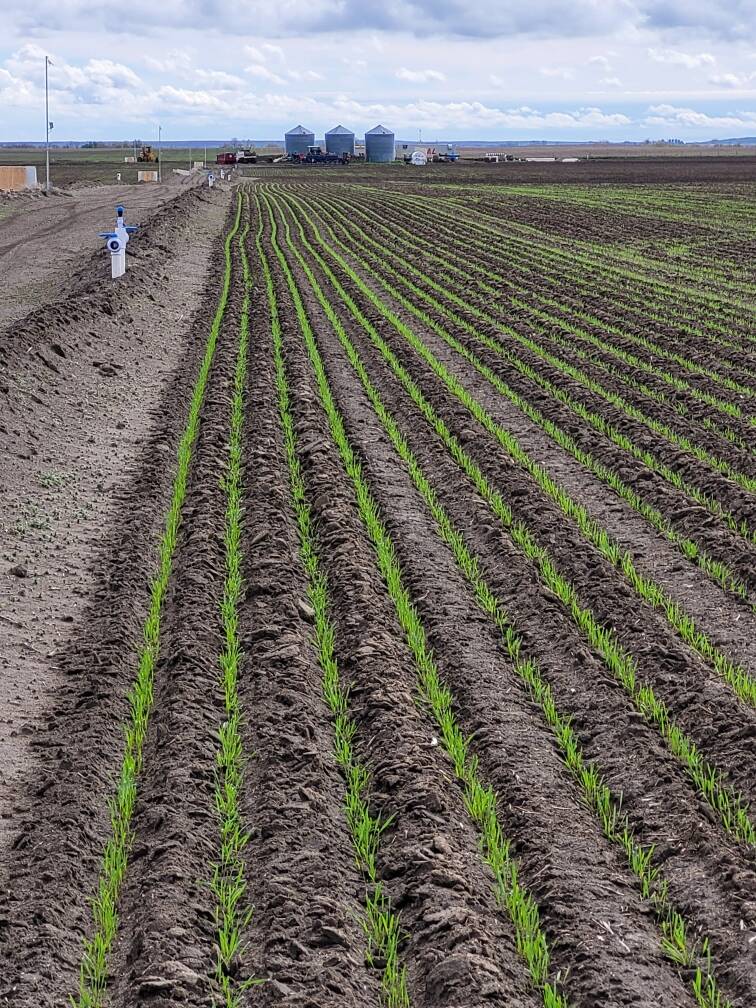
One of the most eyebrow-raising innovations is sub-surface drip irrigation, the practice of watering from the underground up. It’s not that sub-surface drip irrigation is new, but this system of careful, precise management of on-farm water on a Prairie farm isn’t exactly commonplace.
There are several global providers of this type of irrigation tech. Many are headquartered in Israel, a desert country that had no choice but to reinvent their water usage strategy. Rivulis, Metzer and, the largest, Netafim, provide irrigation solutions to farmers around the world and it was this last company that confirmed the choice to go underground for one Saskatchewan farmer.
Read Also
Why you should preserve your farm’s history
There was a big cast iron dinner bell in the middle of the farmyard where Maggie Van Camp grew up….
If it works there, why can’t it work here?
When Brady Funk and his wife, Lindsay, bought their farm at Wymark, Sask., it was a purposeful choice to better manage risk.
Situated near the South Saskatchewan River, Braylin Acres had all the makings of a sub-surface irrigation farm, but was, admittedly, a fixer-upper when they purchased 900 acres in fall 2021.
“When we bought it there was one old irrigation pivot that was roughly 40 years old, maybe more,” Funk said.
“We entered the purchase of this property with the vision of being able to irrigate but not purchasing an active irrigation property.”
Less than one year later, Funk was in Israel seeing firsthand what sub-surface irrigation looks like in action. He was struck by the lush fields of high-yielding durum, dates and open-air tomatoes juxtaposed by beige desert hardscape.
“It was a very eye-opening experience to see agriculture being done on an excellent level with extremely limited resources. … It was crucial to see this being done on small-scale at excellence.”
So, he asked himself: “How can I do it on large-scale and at excellence?”
The setup
Funk’s goal to become Canda’s largest sub-surface drip farm was grand, and there was a lot of work to be done.
- First, four miles of caragana trees that ran through the middle of the farm had to be cleared.
- Next, a 1.6-kilometre length of three-phase power was trenched in.
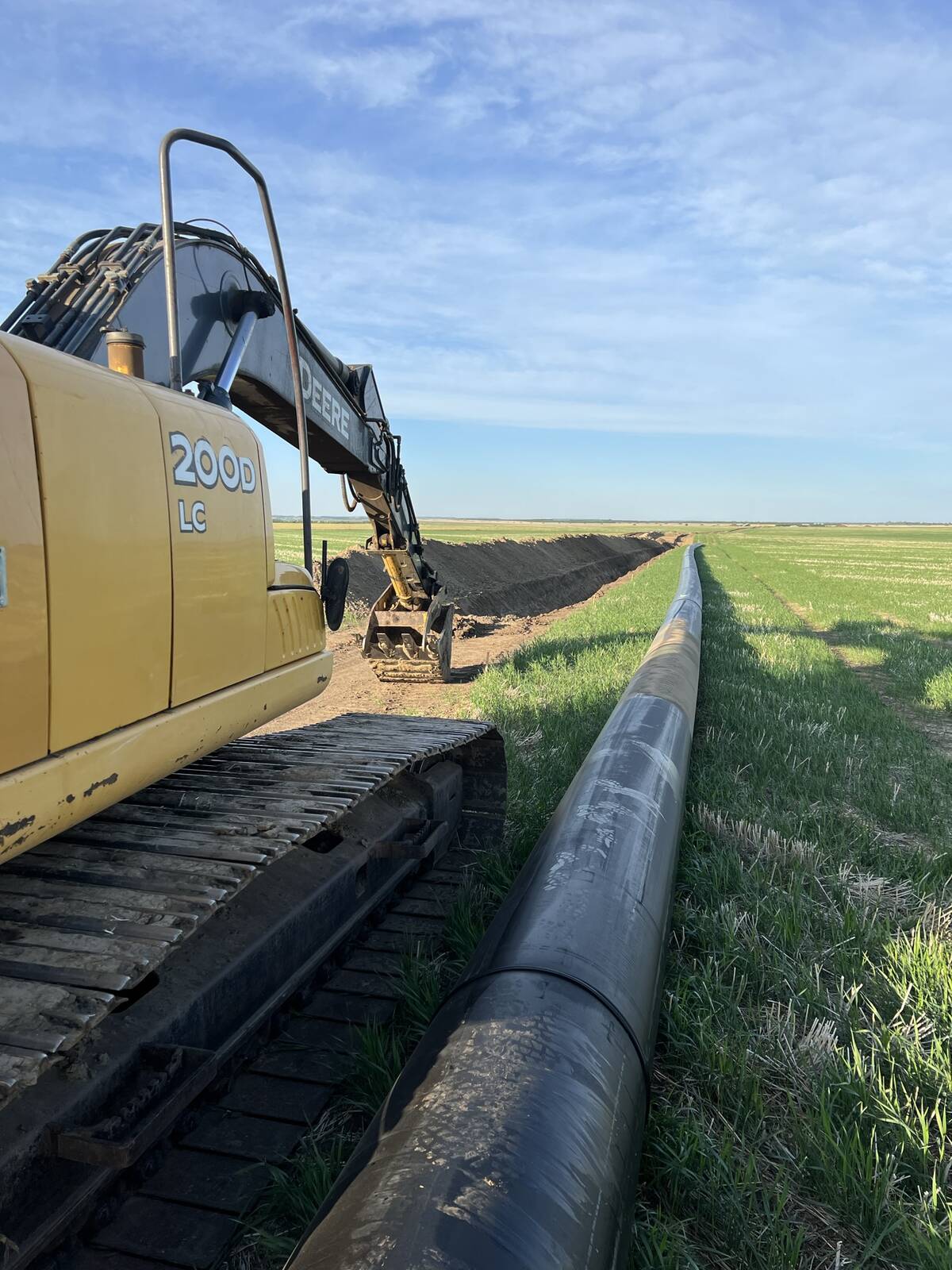
- Then a 4.8-kilometre line of high-density pipe was trenched from the South Saskatchewan River to the farm’s primary mainline.
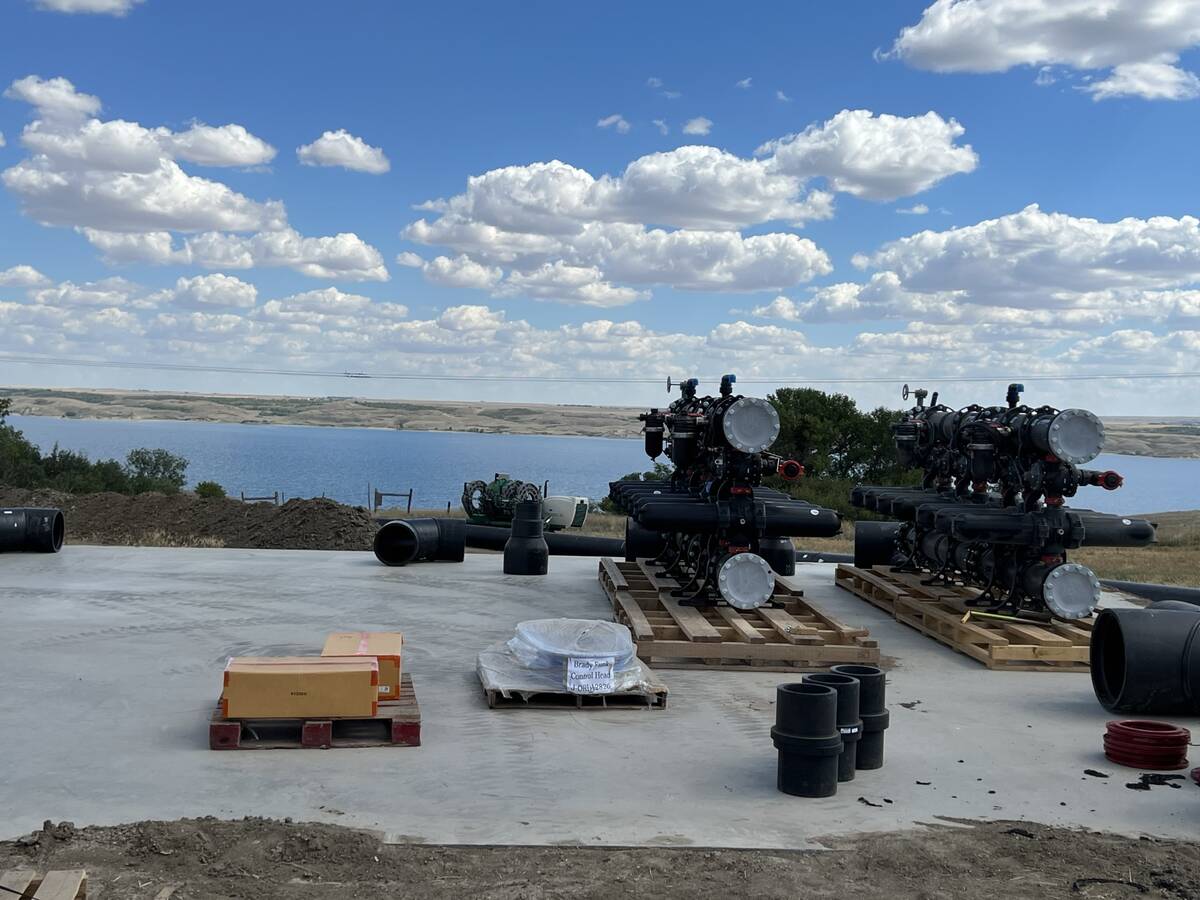
- Concrete pads were installed to hold the filtration systems and houses were built to protect them from the elements.
- Sea cans (large steel shipping containers) were brought in and filled with high-tech electronic systems.
Oh, and did I mention the 4,050 kilometres of irrigation lines that crisscross the farm? The plastic tubing was installed 11 inches down, five rows at a time on 36-inch spacing. End to end, it’s the distance from Toronto to L.A.
“The infrastructure that needed to be put in place prior to even beginning to move a gallon of water was a tremendous job,” Funk said.
The system was set up in two phases over two years (2023-2024) and Funk capitalized on two grants from the federal government.
The first phase was the most capital intensive and involved the installation of the entire main line, power and filtration system. The second phase involved installing a booster pump house as well as irrigation tubing in the last three fields.
Funk said if not for grants the project may never have come to fruition.
The trials
In addition to the broadacre cropland, the family chose to plant one acre of high-value vegetables for the 2025 season, which sold as quickly as it was picked. For 2026, they have settled on three crops that performed exceptionally well: sweet corn, green beans and cucumbers.
Their selection was made based on disease resistance, ease of harvesting and market demand.
Despite the excitement of growing something totally new to them, Funk is the first to admit the learning curve on vegetables is steep, and he still has much to understand.
“Vegetable production is a completely different animal,” he said.
“I feel more comfortable operating a 20,000-acre farm than I do growing 100 acres of vegetables … you need completely different equipment and 10 times more people.”
Growing produce this year wasn’t about the money. It was about understanding what will work, and what won’t. He sees vegetables as much of a long-term play as commodity crops.
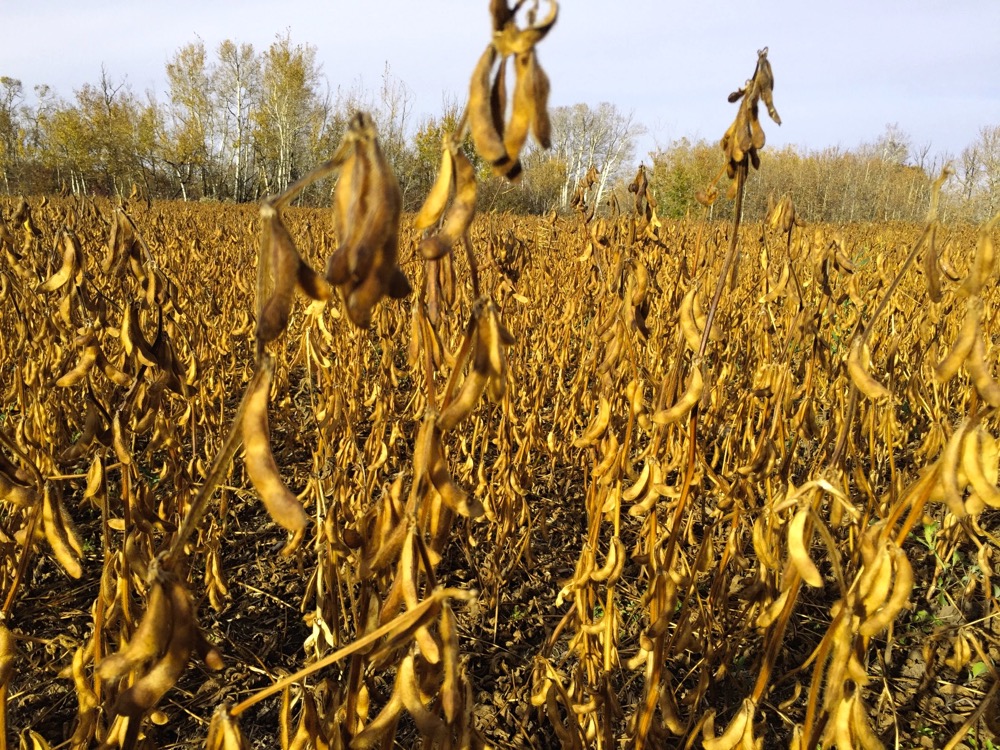
The balance of his 2025 cropland was planted to Blackstrap beans. The results were good, but unexpected kochia pressure knocked off the anticipated top-end yield.
He said 2024 was perhaps more indicative of how this irrigation tech shines when all the variables, good and bad, line up. He seeded all his farm to durum during a horrible drought. The yield gap between his durum relative to other nearby farms was a difference of more than 500 per cent.
“We had a pile of heat units and unlimited amount of water,” he said. “That’s why it’s such a massive spread.”
And, ultimately, this is the goal of such a system, to sidestep the elements and produce the crop you intend to, not the one you hope for.
Numbers don’t lie
Just because it’s irrigation, doesn’t mean it’s as simple as turning on the taps.
Funk hired a full-time irrigation specialist to manage the farm’s water system. He says he irrigated way less than he should have in 2023 while getting a handle on things. In 2024, water usage was “ramped up” and the results were much better. Despite using what he felt like was a lot of water, savings were remarkable.
“If you have a coulee in the way, you couldn’t put a full pivot out there. That’s where you start to see that a drip line can be put in pretty much wherever you want. You can irrigate it a lot more efficiently than if you had to put in a bunch of small pivots.”
Ryan Husband
Irrigation Saskatchewan executive director
Compared to traditional pivots, data showed a water savings of 30 per cent. Since plants are watered from beneath and the tubing goes squarely into the corners of a field, it means nothing remains dry compared to pivots that produce a circular area of coverage.
It also means that water loss is virtually zero. Funk’s fields are broken into 10 15-acre zones and taps can be turned up or down on fertilizer and water. He can have as little as 1.2 gal./ac. or as high as six-plus gal./ac., although he’s never used that much water to date.
“There is no evaporation with our system and we’re just being so precise with how we’re delivering the water,” he said.
Funk’s entire farm is remotely monitored, and soil probes are found throughout his fields. It all links together through a Galcon controller that connects to the cloud and users’ smartphones.
Another savings — both to the environment and bottom line — the absence of disease. Since starting on a sub-surface system, Funk only applies a preventative fungicide spray once per season and nothing more. Because the plant is never purposely wetted, disease has all but disappeared.
“We’re not watering the foliage of the plant; therefore, we don’t need to be so concerned with introducing disease to the plants,” he said.
“When you’re constantly making the plant wet, it is just inevitable that you’re going to have disease in your crop. The only time that our foliage in the plant is wet is when we have rainfall.
“I have not seen disease in our fields in the three years that we’ve been in production.”
Beyond precise control of his water, Funk also uses the system to feed fertilizer. The practice of fertigation, where liquid nitrogen is delivered through the tubing, is another aspect of sustainability from a plant health, financial and yield point of view.

Research has demonstrated that sub-surface fertigation can also lower the amount of volatilization that occurs compared to granular fertilizer applications.
Each year, Funk front loads his crop with 50 per cent of its annual fertilizer in a floating process. From there, he microdoses plants directly in the root zone at the exact right time with liquid nitrogen. He likens the minute nitrogen feedings to a growing teenager, giving them what they need at the right time for maximum results.
Plant emergence and tillering are quieter growth periods, but as heads fill and flower, plants are hungry. In 2025, he fed his beans nine times post-emergence. He conservatively estimates he has saved at least 15 to 20 per cent annually on his fertilizer bill.
The results, Funk believes, are speaking for themselves, even just a few years into this new venture. He sees no reason to believe that such a system can’t work on any farm. He does warn, though, with a friendly laugh, to be prepared for what’s ahead: lots of work.
“It’s going to definitely provide a valuable piece to your operation that is able to guarantee crops throughout your entire farm. We all want to remain competitive, and we all want to do the best with what God has given us. So, if it’s something that would fit your portfolio and would be an asset to the long-term success of your operation, then take a serious look at it.”
The system works in many settings
Ryan Husband is the executive director of Irrigation Saskatchewan, a four-way partnership between the federal government, the Saskatchewan government, the University of Saskatchewan and the agriculture industry. The group collects a levy and uses the fees to carry out research and advocate for irrigators. With a few instances of sub-surface drip farms popping up, Husband can see the allure.
“If you have obstructions in your field, pivots wouldn’t make sense,” he said. “(But with subsurface drip irrigation) you just drive around the power lines and keep putting your drip line underneath it. With pivots you get 133 on a typical quarter-section, but with drip you are irrigating your whole 160 acres.
“If you have a coulee in the way, you couldn’t put a full pivot out there. That’s where you start to see that a drip line can be put in pretty much wherever you want. You can irrigate it a lot more efficiently than if you had to put in a bunch of small pivots.”
To measure for themselves what Funk already experiences, Irrigation Saskatchewan is hoping to conduct a joint study with Agriculture and Agri-food Canada to quantify sub-surface drip irrigation’s impact for themselves.
Husband says fertigation is equally interesting and offers significant potential. For starters, he believes it could eliminate a fall pass with the tractor and anhydrous tank in tow.
Second, it allows a farmer to spoon-feed the fertilizer to plants which reduces the risk of it moving to an inaccessible part of the soil. This is particularly true for nitrogen.
“It also helps you prevent feeding weeds because you’re not putting a bunch of fertilizer down that your crop may not be ready to use yet,” Husband said. “The weeds sometimes then use it up while waiting for the crop to mature.”
He warns, though, that sub-surface drip systems cost roughly double a traditional pivot system on a per acre basis. This is in addition to the cost of bringing water and power to your farm from the source.
He says upfront capital is the biggest barrier. Another issue is gophers, which are known to chew through the tubing, requiring a messy, muddy fix.

Overall, Husband expects to see more systems like Funk’s as time goes on. As the cost of farming continues to increase, sub-surface will be seen as a viable long-term solution.
“Fertilizer and input costs in general probably aren’t going down a whole lot, so it’s about trying to find efficiency in how you use those inputs,” Husband said. “There are certainly some benefits, just getting straight into the root system. It seems to make sense.
“Beyond good stewardship of our water, it also overcomes some typical obstacles for pivot irrigation like houses, trees and power lines. Keeping the canopy dry and only feeding the root zone also helps reduce disease pressure that can reduce passes with the sprayer and improve overall crop health,” he said.
As Funk moves into year four, dedicated to seed canola production and another couple acres of high-value vegetables, he is excited for what’s ahead.
Ultimately, it’s producing exactly what he wants for customers: cleaner food.
“My hope is that we can produce a higher quality food that’s actually better for human consumption because we’re not applying (as much crop protection). It’s more of a natural product than conventional products that are on the market.
“I’m always conscious of being the best steward of our land that we possibly can. Are we doing that by implementing a drip system? I think so.”