

It’s 5:30 a.m. and the milking robots aren’t responding. The barn temperature is climbing, the feed system is frozen, and your herd tracking app won’t load. You’re not dealing with a power outage. You’ve been hacked.
This might sound dramatic, but it’s becoming a real possibility for Canadian farmers. As agriculture embraces automation, cloud platforms and remote monitoring, the risks of cyberattacks are growing — and most farms aren’t ready.
In fact, a recent study by MNP and RealAgristudies found that only seven per cent of farmers say they feel very knowledgeable about cybersecurity and nearly 80 per cent don’t have an incident response plan. And while tech adoption is accelerating, basic cyber hygiene often lags.
Read Also

Farm & Family – March 6 edition
Can a farmer also be a conservationist? The short answer is “yes.” But it’s a balancing act and an on-going…
So, what should you do if your farm goes offline? And more importantly, how can you prevent it from happening in the first place?
The new front line: Cybersecurity in agriculture
Farms today are more connected than ever. Robotic milking systems, GPS-enabled ear tags, automated feeding and cleaning systems, and cloud-based management platforms are all part of the modern operation. These tools bring efficiency, but they also create new vulnerabilities.
Take automated milking systems, for example. Many people use proprietary communication protocols that aren’t encrypted. That means a hacker could intercept or alter commands, disrupting the milking process and potentially harming cow health.

Or consider the sensors monitoring barn temperature and humidity. If those devices still use default passwords (which many do), they’re easy targets. A cybercriminal could manipulate the data, leading to poor decisions or even equipment failure.
Even GPS tracking isn’t immune. Spoofing or jamming signals from cow ear tags can throw off herd management, delaying health interventions or causing animals to go missing.
And then there’s the cloud. Many farms rely on cloud-based platforms to manage everything from herd health to finances. But weak authentication or misconfigured access controls can leave critical data exposed or even enable attackers to shut down operations remotely.
Real risks, real consequences
The impact of a cyberattack on a farm isn’t just technical; for the modern farm, it’s deeply operational. If your feed system is compromised, cows might be underfed or overfed. If your cleaning schedule is disrupted, hygiene suffers. If your milk cooling system is tampered with, spoilage can occur before you even realize there’s a problem.
These aren’t hypothetical scenarios. They’re increasingly common in sectors such as dairy, where automation is widespread, but cybersecurity isn’t always top of mind.
And the consequences go beyond the farm gate. A breach in your supply chain tracking system could delay deliveries, tamper with safety data or damage your reputation with buyers and consumers.
Building a cyber-resilient farm
Now that we’ve got the bad news out of the way, the good news is that you don’t need to be a tech expert to protect your farm. Cyber hygiene starts with a few simple, practical steps:
- Change default passwords on all devices. It sounds basic, but it’s one of the most common entry points for attackers.
- Make sure your systems, especially those controlling feeding, cleaning and environmental conditions, are running the latest firmware. Updates often include security patches that close known vulnerabilities.
- Segment your network so that your IoT devices (such as sensors and trackers) aren’t on the same system as your business operations. That way, if one part is compromised, the rest remains protected.
- Don’t forget about data encryption. Whether it’s temperature readings or herd health records, secure transmission helps prevent tampering.
- It’s worth investing in monitoring tools that can flag unusual activity, such as a sudden spike in barn temperature or a feed schedule that doesn’t match your usual routine.
- Limit remote access. If vendors need to log in to your systems, make sure it’s done securely and that you know exactly who has access and when.
What happens if you’re hit?
Even with safeguards in place, no system is bulletproof. That’s why having an incident response plan is critical.
Know who to call, whether it’s your IT provider, your insurance broker or a cybersecurity expert. Have a checklist of systems to shut down, data to back up and steps to take to get back online.
In terms of insurance, make sure your policy covers cyber incidents. Many farms are underinsured in this area. Coverage should include data recovery, business interruption, legal costs and notification requirements. Increasingly, farmers are choosing specific cyber policies to protect their modern farm from modern risks. These policies typically also include coverage for payments that are made due to fraudulent payment requests.
The bottom line
Cybersecurity might not be the first thing you think about when you walk into the barn, but as technology becomes central to farm operations, it needs to be part of your daily management.
You don’t have to overhaul your entire system overnight. Start with the basics: strong passwords, regular updates and a plan for what to do if things go wrong.
Because when your farm goes offline, it’s not just about lost data. It’s also about lost time, lost product and, potentially, lost trust.
Meghan Mackenzie Bell is a seasoned farm insurance specialist with deep expertise in equine and agricultural coverage. As associate vice-president of sales for NFP’s equine and farm division, she leads strategic initiatives to enhance sales operations and streamline proposal creation, helping Canadian equine and farm clients protect what matters most. You can contact Meghan at [email protected]
Is your farm hackable?
As newer digital technologies such as AI, robotics, drones, digital twinning and wearables are increasingly used in agriculture, cybersecurity is becoming a big issue for today’s farms and it’s one that isn’t being talked about nearly enough.
“I think farmers need to be aware that cybersecurity is an issue and it’s a growing issue,” says Dr. Emily Duncan of the department of sociology and social studies at the University of Regina, who recently published results of a survey of farmers and industry experts called I grow food, IT people do cybersecurity: Addressing cybersecurity risks in Canada’s agri-food sector.
“The basics of cyber hygiene — regularly updating passwords, using antivirus software, backing up files often — are things that more farmers need to be learning and implementing into their business practices,” she says.
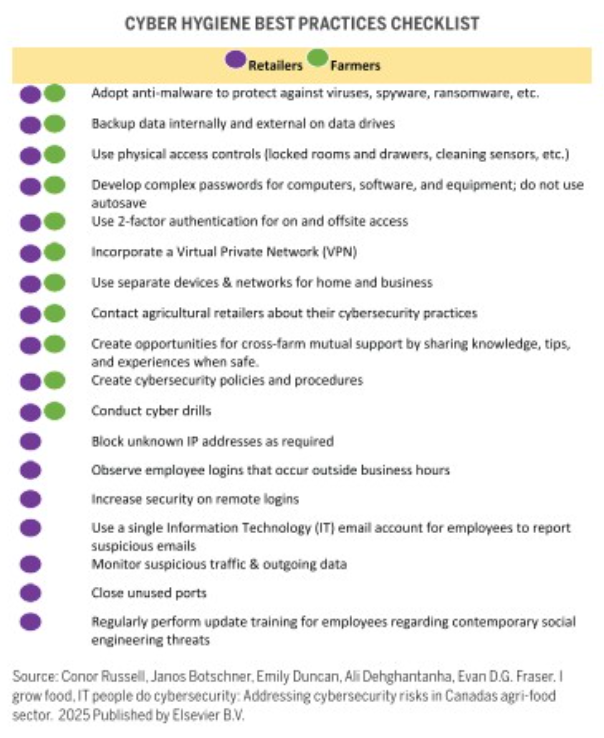
Duncan has put together a checklist of some cyber hygiene best practices for farmers and retailers (see Cyber Hygiene Best Practices Checklist).
The agri-tech industry lags behind many sectors. Duncan says it needs to step up and make sure that when they are developing digital platforms for farmers that they have high cyber security standards in place, such as firewalls and multi-factor authentication.
“There is a lot of room to grow and when we are dealing with living systems, whether it’s animals or crops, they are fragile and in fragile environments,” she says.
“When we think about controlled environment agriculture, such as vertical farming or temperature-controlled barns with 40,000 chickens inside it, if someone hacks that, things can go wrong pretty quickly. Putting those protections in place is super important to protect farming businesses and food security.
— Angela Lovell, CG contributor