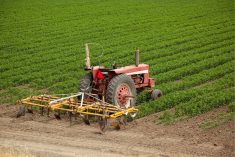

If you’re like me, you didn’t know you’ve already got some solid experience at jump-shifting. Instead, farmers simply went ahead and bought that line-up of no-till equipment and built that new barn, and then figured out how to use them to completely transform the way we farm.
We jump-shifted. We just didn’t know that what we were doing had a name, or needed one.
But there’s more — much more — to the business strategy of jump-shifting than simply slapping a new label on an old behaviour. Because, if the experts are right, jump-shifting is about to get a lot more crucial to our success.
Read Also
Farm & Family – March 20 edition
As part of our International Year of the Woman Farmer content, we recently introduced readers to Renee Ardill, the third…
Jump-shifting says you can’t inch your way into tomorrow’s emerging technologies, not if you expect all their benefits. Sure, it’s possible to add GPS to your equipment one unit at a time. It just may not be wise.
If you’re really going to tap into the full efficiency of auto-guidance, you need to bite the bullet at some point and commit whole hog to integrated self-steer, variable-rate farming.
Agriculture has sort of jump-shifted in past, such as with the introduction of tractors and then with hydraulics, and more recently with big combines with yield monitors.
When it comes to making decisions about the next big jump-shifts, however, we’ll be betting the farm, either because of the debt we take on to buy the technology, or because our productivity and competitiveness will lag if we don’t make the right purchases at the right time.
“To remain successful, Canadian farmers will likely make at least two jump-shifts in their lifetime,” says John Anderson, agri-business and farm succession advisor with KPMG in Kingston, Ont.
These jump-shifts will be huge commitments, Anderson says, and they will need to be planned for. On the most successful farms, in fact, they will often be planned for long before we even know what the technology is.
Plus we’ll need to get better at the challenges of managing debt and human resources under change.
If managing for growth and if technologically driven productivity are part of your business plan, then this is the stuff that should really get your mojo going.
Look before you leap, but recognize that you’re going to have to leap to stay competitive. So the goal is to shift from daydreaming about how to improve, to actually making it happen — smart. For forward-looking farms, here are six steps towarch achieving that goal.
1 BUILD NEW REVENUE STREAMS
In agriculture, new technology rarely comes cheap. If you plan on making a jump-shift, not only will you need capital, you will also need to increase revenue to cover that extra debt, maybe even before you leap.
Anderson says he talks to low-debt, high-equity farmers in excellent financial positions who believe they’re ready to move to the next level of technology. They’re right, but only half right. Based on their debt position, they’re eligible for the loan. However, when you project cash flow following the investment, the picture changes.
In cropping operations, a custom business can sometimes speed up the pay-back on new technology. Consider a farm where a large square baler would save hours of labour but needs a big bale chopper to make it work. If you ask, it may turn out that several neighbours want straw chopping, and this new revenue stream may help pay for both the baler and the chopper.
With intensive livestock operations the question can be, which comes first, the production or the facility? Imagine a dairy family with 70 cows that wants to build a new freestall barn and eventually fill it with 200 cows. After taking out a building loan, they have less than 50 per cent equity and their extended net cumulative cash position — including more principal payments and interest — suddenly doesn’t look as appealing.
Alternatively, they could start growing their revenue, in this case by slowly investing in cows and quota. Their current facilities were filled to capacity so they had to adopt some temporary measures. They milked in two shifts and rented a nearby barn to move their dry cows and heifers out of the old barn. This made room for more cows. Four years later, they had to buy only 20 kilograms of quota to fill the 200 cow barn and were now in a much better net-revenue and debt-servicing position to acquire financing.
2 OWING VERSUS LEASING
KPMG’s Anderson doesn’t mince his words: “You need to be open to all business relationships that allow for increased productivity and efficiency.”
Consider custom work, joint venture purchases, and informal agreements to share equipment. It could be back to the barter system. For example, one farmer might no-till drill some pastures in return for getting manure spread on his land. Both farms benefit.
Increasingly, these relationships can involve working with relatives or non-relatives, or long-term neighbours or new immigrants. You can have written formal agreements or an informal handshake. Of course, you need to protect yourself and balance the risk of sharing with the risk of not adopting the technology. “Part of the answer may be multiple users,” says Anderson.
Leasing equipment instead of owning may be another option, or hiring a custom operator.
You can lease almost anything these days, from grain storage to presses for alternative fuel. It’s not just combines and tractors any more. Leasing may help you with an expansion or taking your farm business in a new direction that you otherwise couldn’t afford.
“If you can acquire new or used equipment without impacting your debt-to-equity ratio, then that may be a motivator in obtaining a piece of equipment that can help you to earn more revenue, or maybe it will save you time in helping you to be more productive,” says Natalee Pollard, agricultural account manager for Winnipeg-based National Leasing.
A custom operator may have a yield monitor on their combine that matches with the GPS maps from your sprayer. By hiring or leasing the combine instead of buying it, you can make the jump-shift, allowing you to access the latest technology without accumulating more debt.
In short, a jump-shift is only useful if it doesn’t destroy your cash position.
3 MAKE TIME FOR SPREADSHEETS
Nothing sings like a spreadsheet, especially one that projects a growth in net revenues based on capital investment. Planning ahead allows you to evaluate many scenerios for getting your own spreadsheets to sing that song, so be sure to keep your eye on contribution margin.
As a rough benchmark, Anderson
says, every $100 that you invest in farm projects should earn a $40 net return after direct expenses. That allows for the leftovers to cover things like principal and interest payments plus taxes and, importantly, lifestyle needs, including the $40,000 to $60,000 per family that Anderson says you need to budget for living costs.
Projected budgets should also include a decrease in labour costs. “With every other business, new technology replaces human labour,” says Anderson. “Why should agriculture be any different?”
A jump-shift can fundamentally change your labour needs, making your business over-employed or underworked. The hard reality is, you may have to be prepared to let staff go or expand into something else.
4 LEARNING HAS A COST
You should also be prepared for a period of adjustment. Just because you’re making a jump-shift, don’t assume you’ll get all the benefits right away. “I call it a cash flow drag,” says Anderson. “Budget a five per cent decrease in gross revenue for the first couple of years and a 10 per cent increase in your variable costs.”
This happens for multiple reasons. Often bugs need to be worked out, and if you’re changing field management, you need to anticipate downtime as you and your employees learn the new system, sometimes getting it right and sometimes getting it wrong.
There are biological realities too. New construction can disturb soil or bring in bacteria, viruses or other disease-causing organisms. Botulism is the classic example of a soil-held bacteria that appears in new barns. Even careful building crews can inadvertently carry diseases from other livestock facilities.
There can be glitches back at the office too. Maybe the new computer won’t be compatible with another system, or it may take longer than you anticipated to set up the new wireless antenna.
“This learning phase causes a dip in management ability,” says Anderson.
5 CAN YOU MANAGE IT?
Are you able to manage under the new system? Managing different technology is different, says Anderson, and he suggests you learn as much as you can and continually update your skills before you make the jump.
says, every $100 that you invest in farm projects should earn a $40 net return after direct expenses. That allows for the leftovers to cover things like principal and interest payments plus taxes and, importantly, lifestyle needs, including the $40,000 to $60,000 per family that Anderson says you need to budget for living costs.
Projected budgets should also include a decrease in labour costs. “With every other business, new technology replaces human labour,” says Anderson. “Why should agriculture be any different?”
A jump-shift can fundamentally change your labour needs, making your business over-employed or underworked. The hard reality is, you may have to be prepared to let staff go or expand into something else.
4 LEARNING HAS A COST
You should also be prepared for a period of adjustment. Just because you’re making a jump-shift, don’t assume you’ll get all the benefits right away. “I call it a cash flow drag,” says Anderson. “Budget a five per cent decrease in gross revenue for the first couple of years and a 10 per cent increase in your variable costs.”
This happens for multiple reasons. Often bugs need to be worked out, and if you’re changing field management, you need to anticipate downtime as you and your employees learn the new system, sometimes getting it right and sometimes getting it wrong.
There are biological realities too. New construction can disturb soil or bring in bacteria, viruses or other disease-causing organisms. Botulism is the classic example of a soil-held bacteria that appears in new barns. Even careful building crews can inadvertently carry diseases from other livestock facilities.
There can be glitches back at the office too. Maybe the new computer won’t be compatible with another system, or it may take longer than you anticipated to set up the new wireless antenna.
“This learning phase causes a dip in management ability,” says Anderson.
5 CAN YOU MANAGE IT?
Are you able to manage under the new system? Managing different technology is different, says Anderson, and he suggests you learn as much as you can and continually update your skills before you make the jump.
Not only will it give you the knowledge to ask the right questions and avoid problems, you’ll have a network of resources you trust before you need to make that call for help.
More importantly, you have to honestly ask yourself: Do we have the management skill to operate the new technology to its maximum capacity?
Anderson recalls a farm where a father and son team decided they needed to hire a manager to expand. The son retained preferred shares in the corporation and the hired manager assigned him daily work. The manager was a recent graduate, who had experience working with the new type of facilities.
“Sometimes you can save yourselves thousands of dollars by hiring someone with experience to show you how to use it, even for a short duration,” says Anderson.
A few years ago, Anderson bumped into a dairy farming friend whose nose was broken. He had recently installed automatic take-off milkers and the automatic arm had knocked him out cold.
Even though you may not have all the skills to make that jump-shift, don’t forget that you can rely on the expertise of others. Some people are just inherently better at some things than others.
Remember, just because you aren’t good at something doesn’t mean it isn’t the right move for your business.
6 USE OUTSIDE EYES
If you’re planning to make a major change in your operation, Anderson suggests you seek out advice beyond suppliers, your friends and family. A well-informed trustworthy outsider will help you source the best alternatives for your operation and give you an unbiased, broader opinion on how to make it work for your business.
Advisory teams should be made up of people you trust and respect — folks like your banker, your accountant, your financial advisor, your lawyer and a mentor. They should give you fresh ideas, or may ask a question that spurs your business in an alternative direction.
“An advisor can help you put your operation in a global context over a larger time frame,” says Anderson. Advisors can also help you see how the new technology will impact other aspects of your farm.
This is the crucial stage for asking questions. How will we de-invest? Will this new system free up enough time for an off-farm job? What happens if a partner dies or gets divorced? How about the next generation? “These questions can make you nervous and hesitant,” says Anderson. “But it’s better to hesitate now than 10 years down the road when you’re in a crisis situation.”
In reality, when we’re in the building process we tend to focus on the project. Anderson says we need to look at the future and the consequences of a change before we start. This will help your jump-shift succeed.
Look for sources of technology and information from around the world. There may be a better way that’s not currently available in Canada. Don’t be afraid to keep your mind and eyes open to other alternatives and our competitors.
“We need to be conscious and aware of global markets,” says Anderson. “We have to keep our costs in line with those markets if we’re going to compete.” CG
Not only will it give you the knowledge to ask the right questions and avoid problems, you’ll have a network of resources you trust before you need to make that call for help.
More importantly, you have to honestly ask yourself: Do we have the management skill to operate the new technology to its maximum capacity?
Anderson recalls a farm where a father and son team decided they needed to hire a manager to expand. The son retained preferred shares in the corporation and the hired manager assigned him daily work. The manager was a recent graduate, who had experience working with the new type of facilities.
“Sometimes you can save yourselves thousands of dollars by hiring someone with experience to show you how to use it, even for a short duration,” says Anderson.
A few years ago, Anderson bumped into a dairy farming friend whose nose was broken. He had recently installed automatic take-off milkers and the automatic arm had knocked him out cold.
Even though you may not have all the skills to make that jump-shift, don’t forget that you can rely on the expertise of others. Some people are just inherently better at some things than others.
Remember, just because you aren’t good at something doesn’t mean it isn’t the right move for your business.
6 USE OUTSIDE EYES
If you’re planning to make a major change in your operation, Anderson suggests you seek out advice beyond suppliers, your friends and family. A well-informed trustworthy outsider will help you source the best alternatives for your operation and give you an unbiased, broader opinion on how to make it work for your business.
Advisory teams should be made up of people you trust and respect — folks like your banker, your accountant, your financial advisor, your lawyer and a mentor. They should give you fresh ideas, or may ask a question that spurs your business in an alternative direction.
“An advisor can help you put your operation in a global context over a larger time frame,” says Anderson. Advisors can also help you see how the new technology will impact other aspects of your farm.
This is the crucial stage for asking questions. How will we de-invest? Will this new system free up enough time for an off-farm job? What happens if a partner dies or gets divorced? How about the next generation? “These questions can make you nervous and hesitant,” says Anderson. “But it’s better to hesitate now than 10 years down the road when you’re in a crisis situation.”
In reality, when we’re in the building process we tend to focus on the project. Anderson says we need to look at the future and the consequences of a change before we start. This will help your jump-shift succeed.
Look for sources of technology and information from around the world. There may be a better way that’s not currently available in Canada. Don’t be afraid to keep your mind and eyes open to other alternatives and our competitors.
“We need to be conscious and aware of global markets,” says Anderson. “We have to keep our costs in line with those markets if we’re going to compete.” CG