
Ongoing growth and
investing in new technology provide essential base for next generations
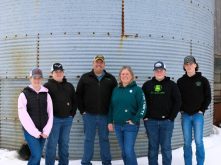
Reg and Richard Gilmer planted the seeds of succession long ago by developing an interest in farming in their children and nephew, and by continually expanding their land and quota holdings.
“If you’re not moving ahead, then you’re falling behind,” says Richard. “And if you can’t live with debt, you’re in the wrong business.”
“Your business has to able to financially support the next generation too, and leave some cash flow for potential growth opportunities,” says Richard. With farming you just never know when those opportunities are or are not going to come along.
Read Also
Farm & Family – March 20 edition
As part of our International Year of the Woman Farmer content, we recently introduced readers to Renee Ardill, the third…
Transparency is one of the keys to a successful succession, says Richard. “They had to realize what pays the bills here. Our major cash flow is coming from the barn.”
In 1998, Gilmer Farms built a 150-stall sand-bedded barn, one of the first in Canada, replacing an old 70-cow tie-stall barn. This allowed them to increase cow numbers and cash flow. Today, they’re at maximum capacity and in the process of building a new calf barn. “If we hadn’t built this barn, it would have been that more difficult to succeed,” says Richard.
Still a challenge
Converting to a free-stall operation, also spurred James’s interest in farming. “I’d rather walk around the barn with a clipboard then with clippers,” James says. “The decisions are for the whole farm, not for Bessy the cow.”
James prefers to manage the cows by group, rather than by the individual animal. Their new calf barn with an automatic feeder will have penned groups of calves instead of individual calf hutches. James hopes to eventually set up their system so that calf groups of eight or nine are moved as a bunch to the heifer barn, through the close-up and maternity straw-pack pens and then into the free-stall barn.
New technology and a right-sized business plan doesn’t mean farming will be easy for the new generation, however.
“It’s going to be tougher for the next generation that it was for me,” says Richard. “They’ll have to watch things closer, deal with more people and there will be more stress.”
James backpacked around Australia, completed his schooling at a couple of different post-secondary institutions and worked off the farm. “I couldn’t think of a better job.”
The long-established working schedule of having every-other weekend off eases gives everybody a break from the continual stress. “Dairy farming is 24-7, 365 days of the year,” says Richard. “Come Friday night, they’re gone. They need a break.”
“They need to get away for awhile, to see what the rest of the world is like, although not necessary,” advises Richard. “They need to know what they’re in for.”