

Legacy runs deep in agriculture.
It’s not just about the land. It’s also about the family name, the farm’s story, the values and the impact that continue long after the current owner has stepped away from the day-to-day. For most farm leaders, there comes a time when the question arises: What happens to the operation after me?
One of the hardest transitions for farm leaders is learning to release control, not in a passive way, but in an intentional, healthy way.
Read Also

Farm & Family – April 10 edition
This week’s newsletter feels very on point with recent news cycles: the constant spectre of uncertainty and volatility. BUT you’ll…
When you’ve built something with your own two hands, poured your energy and heart into it, it’s only natural to want to hold on tight.
But legacy leadership invites you to trust, not just in the people around you, but in the work you’ve already done.
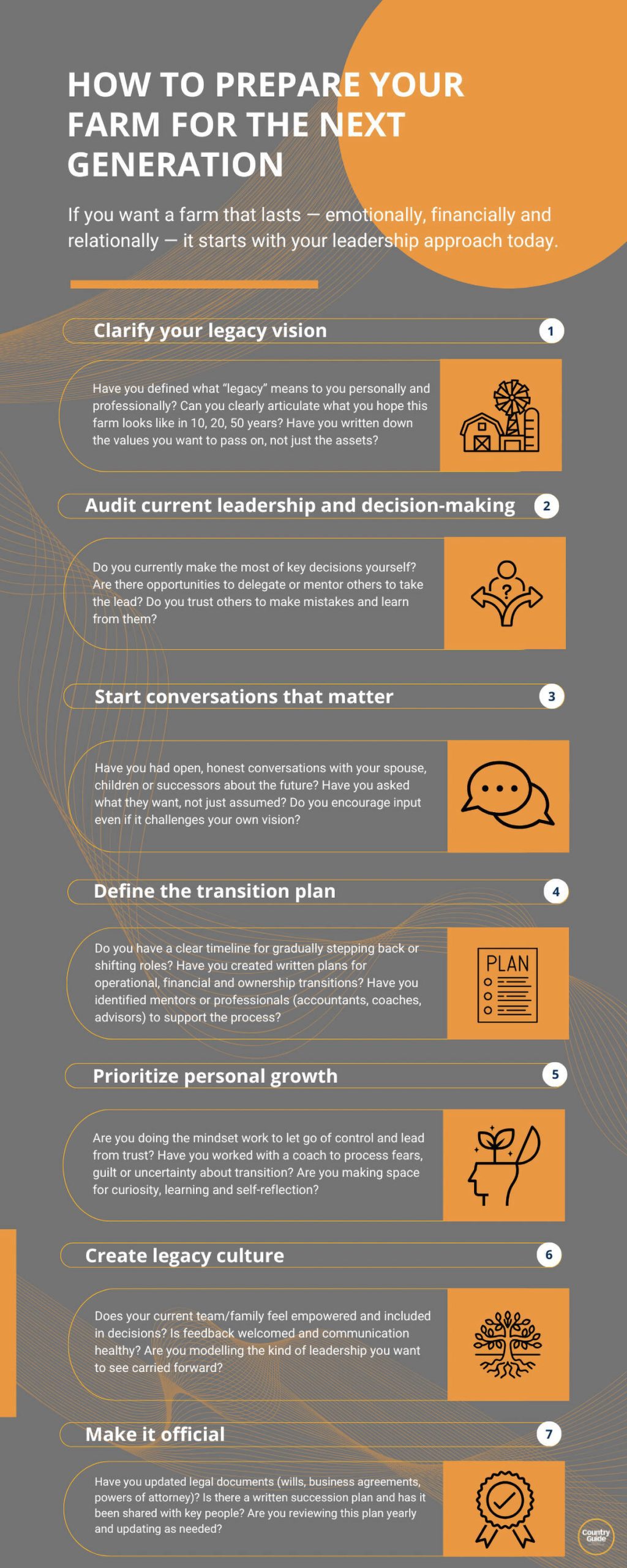
Legacy leadership doesn’t happen by accident. It happens through clarity, planning and communication. When you lead with vision, you create space for the next generation to rise — not in your shadow, but alongside your example.
Legacy leadership requires you to step into a new level of stewardship, one that is guided more by empowerment than management. Empowerment comes from a belief in your worth as a person and trusting yourself to be the leader you need to be. This is where many leaders get stuck. They believe the problem is that their family is not ready or that the circumstances on the farm are not right.
The deeper truth is that most of the resistance lives within the leader themself. But you don’t need to push harder — you need to lead differently.
When working with clients, I like to use horizontal leadership tools and a framework of empowerment. (Horizontal leadership is a style of leadership that focuses on empowering and engaging all members of a team, rather than relying solely on a hierarchical top-down approach.) These approaches help ag leaders simplify what matters, release what doesn’t and communicate what’s most important.
When you lead from this empowered mindset, you stop micromanaging and start mentoring.
You stop overworking and start owning your time and energy.
You stop worrying about the future and start shaping it intentionally.
Passing the torch is a process
I love working with leaders who are ready to think bigger, not just about their business, but about the impact they want to leave behind. With coaching and courses, we work through the core challenges of horizontal leadership: fear, trust, curiosity and vision.
Leadership isn’t about having all the answers. It’s about asking the right questions, communicating with clarity and learning to see yourself and your people through a newly empowered lens.
Leading today for tomorrow’s owners