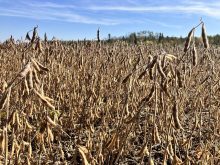


Reuters — U.S. soybean futures fell below $11 a bushel on Monday for the first time since October on uncertainty over whether China will buy as much U.S. supply as Washington expects and as South American crop weather favored large soy harvests that could begin in about a month, analysts said.
Corn and wheat futures followed the weaker trend. Market players awaited a monthly crop supply-demand report due from the U.S. Department of Agriculture on Tuesday, as well as an interest rate decision from the Federal Reserve on Wednesday.
Read Also

U.S. grains: CBOT futures extend gains as cold weather hits U.S.
Chicago grain and oilseed futures rose on Friday as severe cold in U.S. and other areas of the world raised fears about damage to crops and disruptions to processing plants.
Chicago Board of Trade January soybeans were down 11-1/2 cents at $10.93-3/4 per bushel. CBOT March corn was down one cent at $4.43-3/4 per bushel and March wheat was down one cent at $5.34-3/4 a bushel.
Soybeans have fallen from a 17-month high of $11.69-1/2 last month after a trade truce between Washington and Beijing renewed Chinese purchases of U.S. soy.
But the pace of Chinese buying has underwhelmed traders. Including Friday’s announcement of a sale of 462,000 tonnes, total U.S. soybean sales to China since the truce have reached about 2.7 million tonnes, compared with a target of 12 million tons cited by U.S. officials. The USDA on Monday confirmed fresh sales to China of another 132,000 tonnes of U.S. soybeans.
“China continues to slow-walk the purchases,” said Don Roose, president of Iowa-based U.S. Commodities.
Ahead of the USDA’s supply-demand report on Tuesday, brokers will be watching closely to see how the agency adjusts its forecast of U.S. soybean exports for the 2025/26 marketing year that began Sept. 1, 2025.
“The trade is concerned that if the government takes exports down at all, that’s a signal that things are not going that well” in terms of bookings to China, Roose said.
Meanwhile, crop prospects remain strong in Brazil, the world’s biggest soybean producer and exporter. Widespread rains were forecast across the South American country this week, with the heaviest showers expected in southern areas, easing concerns about dryness, weather firm Vaisala said in a client note.
Corn and wheat found light underlying support from USDA projections released on Friday that American farmers will plant less of the cereals next year and shift some area towards soybeans.
— Reporting by Julie Ingwersen; addional reporting by Peter Hobson and Gus Trompiz