

Manila | Reuters — The Philippines’ agriculture ministry expects pork imports to drop five per cent in 2027 and by another five per cent in 2028 as it ramps up efforts to restore pig stocks to pre-African swine fever (ASF) levels, a senior official said on Friday.
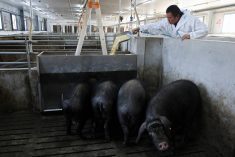
Agriculture Undersecretary Dante Palabrica said next year’s budget includes funding for 32,000 gilts, young female pigs that have not yet bred. They are expected to yield litters amounting to up to one million pigs a year, a major step in repopulating the Philippines’ hog inventory.
Read Also

FCC raises inflation forecast on surging commodity prices
Farm Credit Canada has raised its 2026 forecast for overall inflation as commodity prices spike due to war in the Middle East.
WHY IT MATTERS: Canada exported about $279 million worth of pork and pork products to the Philippines last year according to federal statistics.
“To protect our supply of pork while we are repopulating our pigs, we have to produce one million pigs a year,” Palabrica told Reuters, describing the estimated drop in imports as conservative.
He said the country aims to complete the administration of 500,000 doses of the ASF vaccine by mid-2026, as it aims to move from government-controlled vaccinations to full commercial deployment. As of December 12, 236,000 doses have been given given.
The Philippines, one of the world’s largest pork consumers, reported its first ASF outbreaks in September 2019. Production plunged from about 1.6 million metric tons before the outbreak to 1.1 million in 2020 and 1 million in 2021, and has struggled to recover, with 2025 output expected to reach 1.06 million tons, according to USDA data.
Imports have filled the gap and are forecast to rise seven per cent next year to 750,000 tons, as a result of strong demand and the lingering production challenges.
Brazil is now the top supplier, with shipments from January to October up 56 per cent to 322,076 tons compared to a year earlier, according to Brazilian trade data.
Manila has temporarily banned imports from Spain and Taiwan following recent ASF outbreaks. ASF does not harm humans but spreads rapidly among pigs and wild boar.
Spain has applied for regionalisation recognition, Palabrica said, with similar requests pending from Russia, Germany and Poland. Regionalisation allows imports from ASF-free zones within affected countries, under strict standards.
— Reporting by Karen Lema