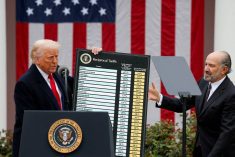


Washington | Reuters — U.S. Trade Representative Robert Lighthizer on Friday said he has notified Congress that the new U.S.-Mexico-Canada trade agreement will take effect on July 1, a month later than initially proposed.
In a statement, Lighthizer said both Mexico and Canada had taken measures necessary to comply with their commitments under the U.S.-Mexico-Canada Agreement (CUSMA), which replaces the 26-year-old North American Free Trade Agreement (NAFTA).
Some industries, including automakers, had been arguing for a delayed implementation because of the difficulties they are facing from the coronavirus pandemic.
Read Also

More canola, spring wheat likely to be seeded this spring
As spring planting approaches, farmers are busy planning which crops to seed this year and how much. With that, market thoughts have turned toward planted area projections, as Statistics Canada is set to issue its report on Thursday.
Mexico had asked the U.S. and Canada for a longer transition period for the auto industry to certify that it was meeting new, more stringent North American content rules.
Lighthizer said his office would work to ensure a smooth implementation of the new trade rules.
“The crisis and recovery from the COVID-19 pandemic demonstrates that now, more than ever, the United States should strive to increase manufacturing capacity and investment in North America,” Lighthizer said in a statement, calling CUSMA’s entry into force “a landmark achievement in that effort.”
The accord includes tougher rules on labour and automotive content but leaves US$1.2 trillion in annual U.S.-Mexico-Canada trade flows largely unchanged. U.S. President Donald Trump had been a critic of NAFTA.
— Reporting for Reuters by Andrea Shalal and David Lawder.