
Ottawa | Reuters — Prime Minister Mark Carney has earned global admiration for openly declaring the end of a global order based on rules, but he has had far less success addressing a growing and more day-to-day concern at home: the rising cost of food.
Among Group of Seven countries, Canada recorded the highest rate of food inflation in December, according to government data. Food prices rose by 6.2 per cent in December, double the rate in the U.S., and more than three times the rates in France and Germany.
Read Also

USDA attachés forecast some changes in China’s oilseeds, cereals
As China heads into the 2026/27 marketing year, the United States Department of Agriculture attachés in Beijing projected a few minor to moderate changes in the country’s soybean, canola, corn and wheat crops.
Carney leads a minority government and relies on support from other parties to pass legislation and stay in power. While Canadians have consistently rated Carney as the best leader to deal with threats from U.S. President Donald Trump, voter sentiment could change quickly if concerns about American aggression lessen — and cost-of-living issues become more urgent, as they have in Britain, the U.S. and elsewhere.
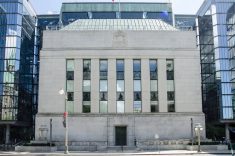
A statement from the Bank of Canada this week noted that grocery prices jumped by 22 per cent in the last three years, compared to 13 per cent for other consumer prices. The central bank said last year’s food inflation was mostly driven by imported foods, supply shortages caused by extreme weather and the significant depreciation of the Canadian dollar in 2024.
Carney announced last week that the country’s poorest 12 million people will get a tax credit for the next five years, “to make sure Canadians have the support they need now.” The government is also taking other measures, like setting aside C$500 million to help businesses deal with supply chain disruptions and allowing producers to write off greenhouse expenses.
Tax credits and supply chain support
But the measures do little to lower food prices in Canada, which is now the biggest driver of inflation, according to Jeremy Kronick, director of the Centre on Financial and Monetary Policy at the C.D. Howe Institute think tank in Toronto.
“This will mostly provide relief to people who are choosing between paying rent or buying food, but it is not going to bring food prices down,” said Michael von Massow, a professor at the University of Guelph who specializes in food economics.
John Fragos, press secretary for Finance Minister Francois-Philippe Champagne, said the new government initiatives were only a first step towards curbing food costs.
“We’ve bridged the food inflation gap as it exists now and we’re taking aim at structural issues that will, over the medium and long term, bring down the price of groceries,” said Fragos.
In late 2024, ex-Prime Minister Justin Trudeau also announced a two-month suspension of a sales tax on selected goods “to give Canadians more money in their pockets.” It had mixed results, with some sectors like restaurants reporting increased sales while other businesses did not see an impact.
Canada’s unique grocery market problems
Academics point to entrenched issues including the dominance of just five companies in the grocery sector, a shorter growing season for produce in Canada, and a reliance on the U.S. that has resulted in higher prices via supply chain disruptions.
“There are some uniquely Canadian problems that make the cost of food here so very expensive,” said Michael Widener, who studies food systems at the University of Toronto.
“Labour and transportation costs are higher, and geographically, we are not close to many other markets,” he said, adding that the dependence on produce from the U.S. and Mexico made Canada extremely vulnerable.
Sylvain Charlebois, an expert in food distribution at Dalhousie University in Nova Scotia, said the government should focus on efforts like eliminating high transportation costs between provinces, addressing the high internal costs of production due to labour laws and the industrial carbon tax among other constraints, and increasing competition within the grocery sector. Canada is a major producer of canola, wheat, dairy and meat but is almost entirely dependent on imports of fresh produce during the winter.
Fresh fruit and vegetables routinely cost at least twice as much in Canada as they do in Britain and elsewhere in Europe; a two-pound bag of carrots in Canada costs $2.21, compared to $0.95 in Britain and $1.18 in Germany, according to online retailers.
Food prices ‘not a voting issue’
Conservative leader Pierre Poilievre has long railed against the high cost of food for Canadians, but that has not translated into increased support. He still trails Carney by double digits in opinion polls — and Carney’s approval has risen since his widely praised Davos speech that openly called out the world’s superpowers for using “economic integration as weapons,” according to several polls.
A poll by Nanos on January 30 showed 54 per cent of Canadians approved of Carney but also noted that 11.4 per cent said inflation was their biggest concern, up from 9.3 per cent a month earlier.
The Conservatives’ co-deputy leader Melissa Lantsman told reporters on Monday that “no amount of tax rebates” will solve the problem of food inflation, adding that more than 2 million Canadians, or about five per cent of the population, now rely on food banks, the highest-ever recorded number.
Shachi Kurl, president of the non-profit pollster Angus Reid, said despite food costs consistently ranking among Canadians’ top concerns, Trump’s repeated threats to annex the country have translated into a bigger issue for voters.
“For the time being, food prices are not a voting issue,” Kurl said. “But if Canadians think that is something they can hold their leader accountable for, it may yet become one.”
Ashton Arsenault, who was an aide to a Conservative minister under previous leader Stephen Harper, said exorbitant food costs should present an opportunity for Conservatives to win more public support, but that a steady rise in prices over the years have largely left most Canadians resigned to the inflation.
“Even when things get really bad, we are still very Canadian and polite about it and don’t take to the streets to protest,” he said. “This is a very tough problem to fix and it will take political courage to do it.”