

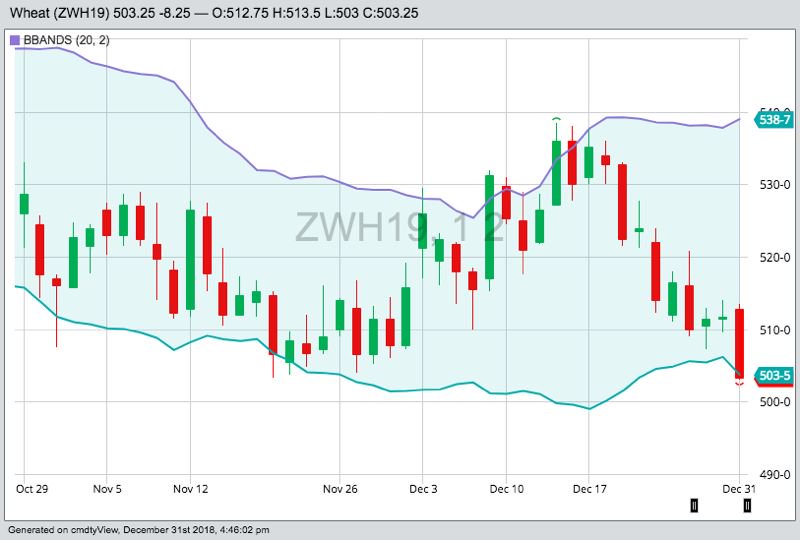
Chicago | Reuters — U.S. wheat futures fell more than one per cent on Monday in thin, technically driven trade, brokers said, but still posted a yearly gain of nearly 18 per cent.
U.S. soybean futures ended lower, retreating from early advances tied to signs of thawing trade tension between Washington and top global soy buyer China.
Corn futures closed narrowly mixed, with nearby contracts fractionally lower in subdued trade ahead of Tuesday’s New Year’s Day holiday.
Chicago Board of Trade March wheat futures settled down 8-1/4 cents at $5.03-1/4 per bushel after touching $5.03, the contract’s lowest since Jan. 24, and the lowest for a most-active wheat contract since Nov. 16.
Read Also

War is increasing food prices, insecurity say IMF, World Bank and UN food agency
The World Bank, International Monetary Fund and the U.N. World Food Programme warn that sharp increases in oil, natural gas and fertilizer prices triggered by the war in the Middle East will cause rising food prices and food insecurity.
CBOT March soybeans ended down 1/2 cent at $8.95 a bushel. March corn finished down 1/2 cent at $3.75 a bushel.
Fundamental news was lacking, and brokers and commodity funds focused on squaring positions on the last trading day of the month, quarter and year.
“Today is a holiday trade environment, meaning it is all sputters, all risk-off for the year-end. The funds are balancing right now, and selling corn and wheat, and a little soybeans,” said Don Roose, president of Iowa-based U.S. Commodities.
Despite Monday’s slip, CBOT wheat ended 2018 up about 18 per cent, its biggest annual rise since 2012, after a sharp fall in production in major exporters Russia, the European Union and Australia, making the grain one of the biggest gainers in commodity markets this year.
Corn also rose this year, climbing nearly seven per cent as tightening wheat supply fueled additional demand from livestock feed makers, offsetting concerns about disruption to U.S. shipments to China.
CBOT soybeans, however, recorded a seven per cent yearly decline after a plunge in exports to China, coupled with big harvests in the U.S. and Brazil, weighed on prices.
A resumption in Chinese imports of U.S. soybeans this month as part of a negotiated truce between the world’s two largest economies helped Chicago prices rebound from a decade low recorded in September.
CBOT soybean futures firmed on Monday in early moves after what U.S. President Donald Trump over the weekend described as a “very good call” with China’s President Xi Jinping.
However, traders remain cautious about the scale of Chinese buying, and a partial shutdown of the U.S. government has added to uncertainty by suspending daily and weekly export sales reports from the U.S. Department of Agriculture.
CBOT soy futures retreated as U.S. cash markets showed few signs of fresh sales, prompting traders to shift their focus to ample world supplies.
“The problem with soybeans is you’re playing a global shell game. Whether we’re shipping soybeans to China, or South America is shipping beans, it doesn’t change the global demand structure, and the trade knows that,” said Jim Gerlach of A/C Trading.
— Reporting for Reuters by Julie Ingwersen and P.J. Huffstutter, with additional reporting by Gus Trompiz in Paris and Emily Chow in Kuala Lumpur.