
Montreal/Toronto | Reuters — Canada’s finance minister and his Chinese counterpart discussed supply chain integrity and other trade matters including tariffs on Canadian pork during talks in Beijing on Friday.
Finance Minister François-Philippe Champagne, who met with Chinese Vice Premier He Lifeng, told reporters he also discussed the impact of geopolitical tensions on the oil and gas market and how China sees Canada as a stable energy supplier.
“We are becoming a partner of choice,” he said.
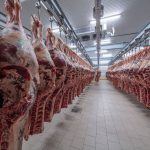
WHY IT MATTERS: While China has lowered levies on Canadian agricultural products like canola, it continues to charge a 25 per cent tariff on Canadian pork.
Read Also

Russian grain ship believed sunk in Ukrainian drone attack found, towed to shore, TASS says
A Russian ship carrying wheat that was believed to have sunk in the Sea of Azov after a Ukrainian drone attack has been found and towed to shore.
The two officials also agreed to hold high-level economic and financial dialogue in the second half of this year, according to an official Chinese summary of the meeting.
Champagne said the discussions centred on the financial services sector but addressed trade in energy and pork, as well as fair labour practices.
“Canada puts a lot of importance on supply chain integrity and that our bilateral trade needs to be conducted in accordance with international standards,” Champagne said.
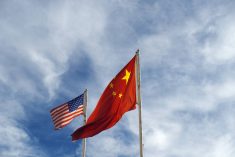
Canada, like China, has been targeted with tariffs by U.S. President Donald Trump since his administration took office in January 2025. Strained U.S. trade relations have posed a major challenge for the Canadian economy.
Among the Trump administration’s actions, the U.S. Trade Representative’s office in March said it initiated a second set of unfair trade practice probes of 60 economies, including Canada and China.
Tariffs on Canadian pork discussed
China is Canada’s second-largest trade partner with about C$120 billion of bilateral trade. Canada aims to increase its overall exports to China by 50 per cent by 2030.
Prime Minister Mark Carney met with Chinese President Xi Jinping in January as Ottawa works to diversify trade away from its largest partner, the United States.
While China suspended some agricultural levies on Canada following Carney’s visit, Beijing still has a 25 per cent tariff on imports of Canadian pork, which Champagne said he raised during the meetings.
“Part of my message to the Chinese side was, really, we need to get to a point where we remove these trade irritants,” he said. “I’m leaving Beijing tomorrow with the feeling that we have laid the foundation.”
Champagne added that the automotive sector was not discussed, following reports that Stellantis was reviewing options for building electric vehicles in Canada with Chinese partner Zhejiang Leapmotor Technology.
He said Stellantis would need to live up to its obligations on investments and workers in Canada.
— Additional reporting from Reuters’ Beijing newsroom